Saturday, 8 June 2013

Hello from very busy Coquette Point,

Lots of visitors turned up this week. First to arrive was Sam Mitchell on his self built, solar-powered bicycle. Sam is 18 years old and he is bicycling around Australia to promote sustainable transport. Sam left East Gippsland in Victoria on March 11 and arrived in Innisfail on Monday June 3. After a little R&R Sam will be leaving Coquette Point to continue his trip bound: Cairns, Normanton, Mt Isa, Darwin, Perth and then across the Nullarbor and back home to East Gippsland.  Sam has a Facebook page and his blog is http://solarshiftaus.blogspot.com 

On June 5, World Environment Day nine Reef Walkers arrived at ANZAC Park Innisfail and were greeted with a welcome to 'sea country' by Mandubarra Elder Henry Epong and later planted a tree in ANZAC Park, Podocarpus dispermus, commonly called the Brown Pine to celebrate the day the Reef Walkers came to Innisfail. This ancient pine tree has a very limited distribution growing between Gordonvale and Innisfail and in the eastern Atherton Tablelands of the Wet Tropics. The brown pine fruits in Spring and produces a bright pink, juicy fruit from which two and sometimes three seeds hang. The fruit is edible and was favoured by Aboriginal people.  Photo in the foreground Nellie Epong with June Norman, Henry Epong and me. Background left Reef Walkers and on the right members of Innisfail Landcare.


The ReefWalkers looked around Coquette Point, they examined mangrove dieback and met cirnio the pelican.


After some R& R the Reef Walkers visited the Reef Guardian School, Mourilyan State Primary School and were greeted warmly by the students and teachers. The Reef Walkers told the students about the walk and answered a lot of questions from the students.


June Norman was delighted to see the reef murals on the wall of the Mourilyan School.


Before the Reef-Walkers left Coquette Point Friday morning they decorated the house with their banners and flags for a group photo.


Then it was back to the Bruce Highway for the Reef Walkers to continue their walk from Cairns to Gladstone.


We had lots of Cassowary visitors this week and were delighted to see, the young cassowary adults 'Don' and 'Q' again. I have not seen these two birds for nearly a year and can only assume when the adult male cassowary 'Snout' disappeared following his courtship with matriarch cassowary 'Jessie' the young birds have, now with 'Snout's' absence returned to the area they occupied as chicks.

'Don' on the right has developed a bustle for a tail and struts around like a dancer. He examined the pig cage and was not at all impressed and started drumming and prancing around the cage, perhaps he could smell the pigs.

My pig cage is baited with coconut and has a push-open door which the cassowaries cannot open. It is an unfortunate fact that many cassowaries are killed by being caught in pig cages. Not only are most of the pig cages used by
trapping programmes the wrong design for 'cassowary country' but as well these cages are baited with food that attracts the cassowaries.  Whereas, coconut, taro and palm or pandanus heart are favoured pig foods they will not attract cassowaries into the cages. It is beyond my understanding why it is not mandatory to have cassowary-safe pig trap cages which are baited with food that does not attract cassowaries, particularly as most of the pig-trapping-
programmes are funded by Government.

I have seen 'Q' almost every day  this week she has been eating crabs particularly fiddler crabs from the beach around the mangroves.


It is so good to see these young birds looking so healthy.


I took the photo on the right of 'Don' and 'Q' on the day their father 'Little Dad' first left them to fend for themselves 25.7.11.

The photo on the left was taken on the January 10 2011 of 'Q' when he had separated from his sibling and it shows the distinct pattern of his wattles.


My previous last photo of 'Don' as a sub-adult was taken on July 21 2012. At this time his feathers were just starting to turn black.


I also saw another young bird which I think is 'Rosie's' sibling. The bird still has a few brown feathers on his tail but for such a young bird has a very large casque and long wattles. This cassowary has very large feet and was walking in front of the houses at the top of the Moresby Range.

It is interesting that these young birds have returned to the built up area at Coquette Point at the time when their mother 'Jessie' has gone off with 'Snout'.


The green emerald doves have returned to the coast and his return generally signals cooler weather is on the way.


Yellow Oriole has also returned to the coast and his loud calls can be heard every morning and afternoon singing out from the top of the rainforest- canopy warning the other birds not to mess with him. Yellow orioles are fruit feeders and their strong red beak can demolish a pawpaw fruit in minutes.


To commemorate the Reef Walkers Margaret Morehouse very cleverly adapted the Australian national anthem. With a Federal Election on the horizon we will soon have to decide what direction we want Australia to follow.

National Anthem 2013

Australians all, let us proclaim,
We're neither young nor free;
With stolen soil our need for oil
Will kill the living sea.

Where once abounded nature's gifts
Of beauty rich and rare,
On history's page, at every stage,
The myth: Australia's fair.

Beneath our radiant Southern Cross
We'll dig with hearts and hands;
Until our landscape suffers loss
Renounced by other lands.

For those who come across the seas
Our bounty we'll not share;
With hubris let us still proclaim
The myth: Australia's fair

In boastful vein let us proclaim
The myth: Australia's fair.

With tears of shame let us proclaim
Australia's far from fair.

If you see the Reef Walkers please give them a wave of support.

Cheers,
Yvonne


Saturday, 1 June 2013

Hello from the end of the Rainbow,


Constant stream-showers interspersed with bright sunshine has resulted in repeated rainbows in the sky above Coquette Point this week, at least two rainbows forming every day, a wonderful phenomenon.

Alas the warm showery weather has created the perfect breeding opportunities for mosquitoes and there is no where to escape the little biting blighters. It has been many years since I have seen mosquitoes this bad.  Fortunately there has not been any new cases of dengue fever reported, but the mosquitoes do make life difficult.


A flock of five sulphur-crested cockatoos are feasting, almost entirely, on the ripe seeds of milky pine trees, Alstonia scholaris, a common tree of the Wet Tropics rainforest. The cockatoos are systematically going from one tree to another and not leaving the tree until every seed has been eaten. Last week they feasted entirely on Alexander Palm fruit. In spite of its common name the milky pine tree is not a pine, however the timber is light and softer than hoop pine. When the wood of the milky pine is cut it exudes a large quantity of milky sap, this sap contains strong alkaloids, which although not known as an Aboriginal medicine, it is used by local people for the treatment of ringworm and other skin conditions.


The sulphur crested cockatoos have been displaying their crest and appear to be pair bonding. Sulphur crested cockatoos nest in hollows in old trees and following the two cyclones in this area in recent years there are a lots of tree hollows for these birds to choose for nesting sites.

On the left the sulphur crested cockatoo has picked the fruit pods of the milky pine tree and while holding the pods in his claw he is carefully extracting one seed at a time from the long pod.


This week for the first time since cyclone 'Larry', over six years ago now, I saw the many coloured,  purple-crowned fruit dove, or superb dove, unfortunately it was very early in the morning and I did not get a good photo. However, it is another sign the cyclone damaged rainforests of the Wet Tropics lowlands are again producing fruits to sustain a diverse populations of birds.

The male purple-crowned fruit dove  is the more brightly coloured of the species and he shares nesting with the female. As he sits on the eggs through the day he is forced to gather food at night. Therefore, with his nocturnal habits he is often difficult to find and although this dove is brightly coloured in the dense rainforest these colours are a perfect camouflage.                                                                             
                                                                             
Local fisherman Ross and his mate 'Crino' are a common site at Coquette Point. 'Crino' waits for Ross to come fishing and  Ross told me the bird never eats the bait out of his bucket however, when Ross catches an undersized fish and throws it back in 'Crino' is onto it in a flash. 'Crino' does not approach other fisherman but has this special relationship with Ross. 'Crino' is named after Ross's home town in Italy.
Crino keeps guard over Ross as he fishes.


Beach stone-curlews pair bond for life and set up and defend a territory. At Coquette Point two pairs of beach-stone curlews keep constant guard over their places one pair at the northern end of the beach and the other pair at the south-western end. Beach-stone curlews are ground nesting birds and as well they also spend most of their time on the ground hunting and subsequently are vulnerable to dog attack. Even incidental play-chasing by dogs can exhaust the bird and prevent it from returning to the nest. Subsequently the populations of these birds has dropped significantly and they are on the threatened species list.

As I was watching, one curlew dug its beak deep into the sand and pulled out a crab.


With a swift movement he put his head back and swallowed the crab whole. 
The wide, shallow, sandy estuary at Coquette Point is a rich feeding ground for waders.               At times some migratory waders will winter over in north Queensland. It could be due to their being juveniles and not strong enough for the long flight to the Northern Hemisphere or they may have sustained an injury or not be feeling well at the time. Whichever way rich feeding grounds like the Johnstone River estuary have some populations of shore birds all year.  
 
As I watched a bar-tailed godwit flew in followed by two pied oyster-catches.


At any time of the year small populations of many species of migratory waders will be found on the rich sand-flats at Coquette Point.          While crested terns were feeding on a sandbank two eastern curlews and a grey tattler waded into the water looking for small fingerlings. At the same time little sand plovers were running along the beach catching ghost crabs.                                                           
  How privileged I felt to have these birds fly in and around me and allow me to watch them feed.
                                                                            Further out I saw a very large tern in amongst the crested terns. The bright red beak was a dead giveaway, a Caspian tern, I could just make out another one on a sandbar out further. It is not uncommon to see a few Caspian terns at any time of the year, however they are not known to breed in the Wet Tropics.

Red-capped plovers were busy pulling worms out of the muddy sand.
At a time of the year when you would not expect to
see a lot of shorebirds I was delighted to encounter
many different species of birds.
                                                                            In the mangroves white-faced heron and little egret were fishing in the backwater.
                                                                           On my return I found 'Crino' by himself, Ross had left and the pelican made no attempt to join the other fisherman.                                                                                                                                                             Glistening turquoise in the bright sunlight a forest kingfisher sat on a dead mangrove tree stump looking for a passing insect to catch.
            The forest kingfisher is the most common kingfisher in the Wet Tropics and often perches out in the open while hunting.    The forest kingfisher has two prominent white windows in each wing which can be seen when the bird is in flight.

Sand erosion at Coquette Point.


The catamaran 'White Beech' was launched this week and while waiting for the tide to come in, some last minute work was carried out fitting the electronics to the hull while the boat was on the beach at Coquette Point. The boat is named from the common name of the giant, rainforest tree Gimelina fasciculiflora, the north Queensland white beech and is a play on Queenslander's 'favourite place'. The white beech tree grows from the catchments to the estuaries of the Barron and Johnstone Rivers. The blue, bell shaped flowers form in spring followed by globular fruit which turn blue when ripe. The fruits fall in summer are eaten by cassowaries. The NQ white beech was heavily logged for its compact, close-grained, cream-coloured timber. The wood was found to be durable in the weather but mostly sort after for cabinet work.                                                                                                                                                                                                   With strong winds expected to continue for the next few days  and the long range forecast predicting a rather wet and windy winter, 'White Beech' is unlikely to venture very far from the river for some time, catamarans are not very durable in bad weather. I 'am not keen on multihull craft; only good for rivers and lakes methinks.                                                                                                                                                                  The effects of wind erosion on beaches is often subtle, however, after several weeks of strong southerly winds the northern movement of the sand bars within the Johnstone River estuary can be seen happening in real time. It reminded me of a tale Les Scheu told when after one storm the Coquette Point sandbar moved so far north it left only a small channel opened and at low tide Les reported he could jump across to the Coquette Point side. As I watched the sand move with the wind this week I could see it happening.  The Johnstone River estuary is a dynamics system and the people who call for dredging should read the history of what has happened in the past when the river mouth was dredged and dredged at great expense. Perhaps they should also come and have a look at what is happening now in these persistent southerly winds.

 
A reminder tomorrow at the Community Gardens Innisfail the 2013 Sustainability Expo will be held commencing at 9am.                         On Wednesday, World Environment Day a rally will be held at ANZAC Park Innisfail from 2pm to 4pm to greet June Norman and the Reef Walkers. June started her walk from Cairns to Gladstone this morning and will arrive in Innisfail on Wednesday 5th June at 2pm. Come and meet June or better still join the walk for as little or as long as you like. www.reefwalk2013.com


Cheers for this week and I hope the sun is shining at your place, happy first winter's day.
cheers Yvonne                                         


Saturday, 25 May 2013

Hello from crisp and sunny Coquette Point,

Winter weather came in with a rush yesterday, the humidity dropped and the clouds evaporated exposing a bright blue sky.
While we all whinge about the rain a friend Doug put it into perspective for me when he returned to Innisfail this week. Doug told me north western Queensland is in severe drought and this year for the first time in over 90 years the Flinders River has not run at all.
Its not just Queensland in drought, the wheat belt of Western Australia is also in a dire situation, they have not received any meaningful rain in over four year.
As Doug drove back to Innisfail along the Kennedy Highway this week he said he saw the countryside suddenly turn green and he knew he had returned to the 'land of big trees'.


The sulphur crested cockatoo is beloved by Australians as a pet bird, however, it is often hounded for the damage it can do to fruit crops. There are many ways to protect crops and sometimes it is only a matter of planting divisionary species. This week I watched  three sulphur crested cockatoos enjoying the ripe fruits on the Archontophoenix alexandrae, the alexandra palm.
As they plucked the fruits I was enchanted with the delicate way these wild birds ate and they were in no great hurry.

 
It was such a privilege to watch these sulphur crested cockatoos  as they fed and interacted with each other. Given the opportunity all animals prefer to eat a diet of their own natural wild food.


Crested hawk enjoyed the change in the weather and for over half an hour yesterday morning sun-baked on the branch of a tall tree. He stretched out his wings to catch the sun's warmth.


When to my amazement a young butcher bird, less than half the size of crested hawk, landed on a branch close to hawk and started screeching obscenities at hawk, or at least that is what it sounded like to me. Hawk flew off to another tree and bossy, young butcher bird burst into a cheeky song telling all that he was master of the canopy.                      
             Golden orb spider is doing very well for herself catching so much food in her web she is in danger of becoming obese, or at least that is Ruth L's concern for the spider on her veranda. Ruth reports her spider now has five male suitors.
 I watched one big girl in my garden as she cleaned her mouth before tackling the next tasty treat and saw a male crawl over her body and around the larder of food without any challenge from her. Of course it was distressing when a beautiful male birdwing butterfly flew into the web.


The yellow sunbirds are in a frenzy of activity and while the female does all the work in gathering material to build the nest the male is always nearby offering advise and standing guard. My veranda is littered with old and new nests. These little birds like to build in sheltered areas away from the rain and often seek the eaves' and verandas of houses.
Hibiscus tiliaceus, the cottonwood tree is in flower along the watercourses of the wet tropics. In the afternoon the petals of this beautiful flower change colour and darken to shades of red and maroon before falling and floating on the water and out to sea.  The falling of the flowers is always a sign that the winter weather is here. The flowers of the cottonwood are edible and make a sweet addition to a salad. The bark of the tree was used by Aboriginal people as well as passing seafarers from which they made very strong ropes.
Higher tides always bring the horn-eyed mangrove crab into the nursery. This is often very disconcerting for customers but children love to chase them.
I often wonder if I removed the nursery how long it would take for the animals and trees to repossess the area. As it is we try to make room for each other.


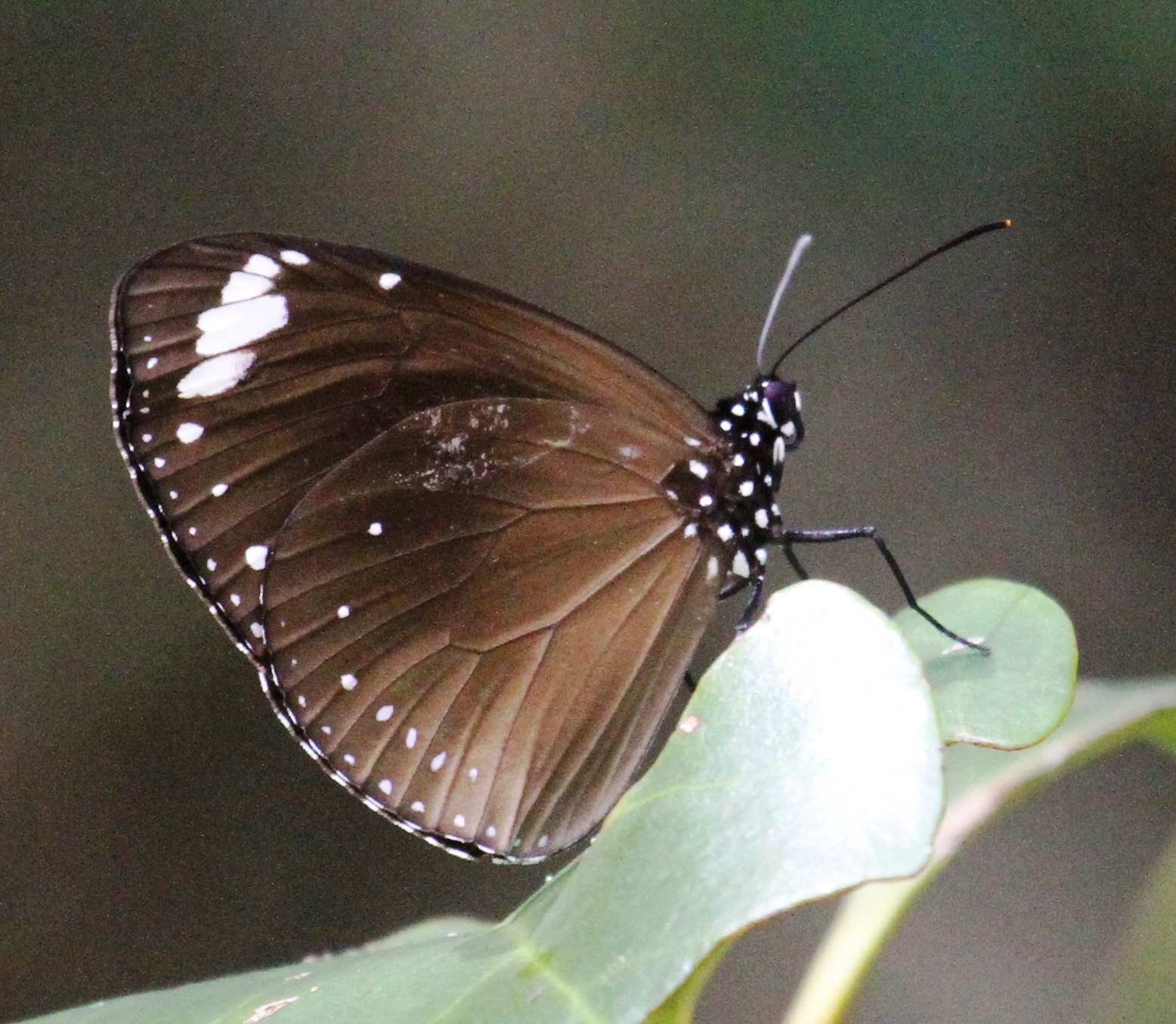
There has been a sudden hatching of common aeroplane butterflies and hundreds of them are flying around the nursery at the moment.


Epiphyte are one single group of plants that particularly distinguish rainforest from other forest types. Epiphytes are plants that use other plants as support without damage to the host. In the dry season many epiphytes dry out but when the rains arrive the epiphytes suddenly burst into splendid growth turning tree branches and trunks into hanging gardens. The swaying fronds of a Vittaria elongate, tape fern, have swollen in the wet season and hang out and down from the rich debris made by an Asplenium nidus, bird's nest fern, all in the canopy of a large Nauclea orientalis, Leichhardt tree.


I was in Tully this week, sitting down having a cuppa with friends when suddenly, cough, cough,  the Tully mill burst into life, the 2013 sugar-cane season has started in the Wet Tropics. Please take care on the roads and keep a look out for cane trains and trucks.


Cheers for this week,
Yvonne