Wednesday, 9 April 2014

Hello from the cyclone coast,

I am alarmed at the amount of complacency concerning the possible impact of cyclone Ita on the greater FNQ coast.

TC Ita's destructive wind radius is greater than TC Yasi. The maximum winds are greater on the southern quadrant.  While BOM is sticking determinedly with a track that differs considerably from the Joint Typhoon Warning Centre at Pearl Harbor when JTWC clearly state 'The bulk of the available dynamic model guidance is in fair agreement, therefore, the forecast is positioned close to the multi-model consensus. The only exceptions are ECMWF AND JGSM solutions, which indicate an UNLIKELY west-southwestward to southwestward track over the Cape York Peninsula'.
The JTWC track map for Ita, below, shows the cyclone curving south and running parallel with the coast from Cooktown to Innisfail as a severe system with destructive winds impacting Cooktown, Port Douglas, Cairns and Innisfail.


The BOM site now includes Innisfail in the grey zone indicating the range of likely tracks of the cyclone centre. BOM does state that due to the uncertainty in the future movement, the indicated winds will almost certainly extend to regions outside the rings on this map.


As I said before TC Ita is a very large system and has a lot of rain associated with it. When the winds move on we can expect flooding, whichever path this cyclone takes.


                    BOM's 5am track-map for TC Ita.


The latest 8 am BOM track-map draws the track crossing closer to Cooktown.


Ita will impact coastal communities along the full extent of FNQ and will impact on inland communities as well.


I spoke to Pat Shears this morning and he said the Cassowaries all disappeared yesterday and the flying foxes did not come back to their roost this morning. He noticed crabs were crawling up the trees. Pat was packing to leave for his house in Herberton.

The Daintree rainforest has not been impacted by a cyclone since TC Rona 10 February1989.

I am busy making preparations here which includes, sharpening chainsaws, checking generator, topping up the water tank, cyclone bolts on windows, removing shade mesh from the nursery, clearing all loose items from outside, filling cars and tractor with fuel and buying extra fuel and food supplies including solar lights.

Take care,

Yvonne

Saturday, 5 April 2014

Hello from Coquette Point,

'The monsoon trough has surged and the United States Military Joint Typhoon Warning Center has declared a tropical cyclone 23P on the monsoon trough. The cyclone is 687 nautical miles east-northeast of Cairns. It will be called
'Ita' by the Australian BOM and the system is now moving west-southwestward at four knots towards the Queensland coast. It is expected to cross the coast, over the top of Cape York, late next week as a cat 1 or 2 cyclone.
This system is producing a lot of rain and combined with a large high in the Bight we can expect to see a very active convergence zone around the Cairns area. Flood rains should be expected all along the Wet Tropical Coast next week.


This is the same system that has caused devastating floods in the Solomon Islands. At least 7 people are dead, 30 missing and 10,000 are homeless, just in the capital Honiara alone, from torrential rain and huge waves which battered the Islands.

The Mataniko River in Honiara broke its banks and swept away houses that were built on the high banks of the River. The riparian vegetation was long ago removed and the natural systems so altered with no environmental oversight, 'green tape', to control the population surge into Honiara from the outer Islands. 70,000 people now live on an 8sq mile Island: they now need our help.
                                                                            

Very good news from Taggs at Coquette Point this week, Cassowary 'Hagar', previously known as 'Little Dad' has turned up with a chick. Taggs first saw them last week when we had the 180 degree rainbow over the Johnstone River, so he has called the new chick 'Rainbow'. Rainbow is about two months younger than Snout's chick Ky.

Ky is growing fast and this week is  feeding on guavas, Leichardt tree fruit and a blue fruit I have not been able to identify.


It has been very hot and humid and Snout and Ky have been coming into the nursery to drink from the waterlily bath. Neither Snout nor Ky any longer take notice of Plastic Cas, they have worked out she is not a threat.


Lace Monitors are very active at the moment shedding old skin and hunting for insects, frogs and eggs.  Diana O'Brien found this one in her back garden at Coquette point. The goanna didn't seem to mind Diana when she went in close to say hello. Thanks for the photos Diana.

Lace Monitors are the second-largest monitor in Australia and can grow to 2.1m in length.


Other reptiles are also active at the moment and Ian Laidlaw at Tupeki on the Palmerston sent me this photo. Ian is a keen photographer and as he said "You've got to be slick to catch the lick." Great shot Ian.
"Lots of frogs about from the constant wet weather over the last month and the snakes are in a frog feeding frenzy, with the nights becoming a little chilly already on the Palmerston."

Thanks for the photos Ian.


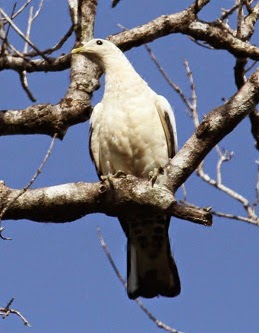
Most of he Pied Imperial Pigeons appear to have left for their 2014 migration as I have only seen one bird this week and Ruth Lipscomb, from the top of the Moresby Range, reports sighting only three birds and they were heading south on a feeding trip, in the early morning.

Wongaling Beach bird watchers also report that the PIPs have left the Mission Beach area.

I have watched the one bird which remains here flying and eating with the Metallic Starlings.


Large flocks of Metallic Starlings can be seen feeding on rainforest fruits all day long. No doubt most will also soon leave for their migration journey to Papua and Indonesia.


The Feast of the Senses Market Day Extravaganza will be held in the Innisfail CDB tomorrow from 9am to 3pm. Over 100 stalls exclusively with local produce, cooking demos and entertainment: a great day out for the whole family.

Cheers for this week,

Yvonne


Saturday, 29 March 2014

Hello from tropical Coquette Point,

A rainbow spread across the mouth of the Johnstone River on Wednesday signalling the end of a month of rain. Thursday was a perfect day, low humidity and a gentle tropical breeze.

The Feast of the Senses, Taste Paradise function held at Coquette Point was a great success: helped of course by perfect weather.

We dined on a selection of tropical dishes of quality and variety to astonish the most experienced foodie.


  The late afternoon was brought to a close with evocative Pacific Island songs and dances performed by James, Lohar and family from the Tokelau Islands.


The leaden flycatchers have arrived to winter over in FNQ.  Although I have seen several males the females do not appear to have arrived.

As yet the calls have not taken on their harsh notes and the boys are spending their days in the mangroves and swamps searching for insects sweetly whistling too-whit, too-whee in a very pleasant tone. No doubt this will change when the females arrive.


Driving home from town this week I saw a cassowary walking down Howe Street towards Coquette Point. I stopped the car and with the camera in hand kept a look out for any cars.

I did not recognise the cassowary, possibly a young female about five years old. The bird appeared to have come from East Innisfail, in the area which is the old Ninds Creek wetlands.

A number of cars approached coming from Coquette Point. All cars slowed and when the cassowary saw the vehicles it crossed the road in front of the cars and went into the area near the sewerage farm.

When the cars passed it crossed the road again and went into the area approved for the Metricon Canal Estate Development.


This cassowary appears in good condition and its movements are an example of the migration of these birds within the Moresby Range - Ninds Creek - East Innisfail populations.

It is imperative to mantain wildlife corridors which link different family groups of cassowaries for the future development of a genetically healthy population. Unfortunately very few safe migration corridors exist in the Wet Tropics for this endangered bird.


Cassowary Ky is growing fast and Snout is a very attentive father.

I saw Snout and Ky in the mangroves and when Ky saw me she hid behind a branch; her now brown colour the perfect camouflage.


It was very hot today and Snout and Ky enjoyed cooling off in the stream.
Lots of jumping spiders around this week and here's three of the eight different species I saw this week.
In the hot humid weather today the lemon migrant butterflies were mating, some on the wing others exhausted with the effort and continued their union while resting on leaves. The females are generally more colourful so I suppose that is 'her' in orange garb below.

When the rain stopped on Wednesday the birds took it in turn to dry and preen on the branches of the old dead trees.
                                                                                                                                                                       
While today in the heat the Pied Imperial Pigeons rested from the midday sun in the shade of the canopy.  
This week I bit the bullet and had full solar power installed.  Of course nothing is ever as easy as it seems and I discovered the power board needs a full upgrade. 
 It was Deja vu for Innisfail electrician Don Clark when he looked at the board with its asbestos backing. Don installed the board when he was an apprentice 40 years ago. As Don said in those days no one knew about asbestos and they cut and drilled it all the time! Australia along with many countries is living with an asbestos legacy that is fast catching up with workers in the building industry.

Tonight, as part of a climate change awareness campaign we are all being asked to turn our lights off for one hour from 8.30 pm. The Australian campaign focuses on the Great Barrier Reef and the irreversible effect our modern way of life is causing to the Reef and the environment generally.

While the lights are out take the time to look at the sky.

Cheers for this week,
Yvonne


Saturday, 22 March 2014

Hello from Coquette Point,

The monsoon is in its death throes and has swept ex cyclone Hadi back onto Cape York as a low pressure trough. Combined with a high in the Bight the Wet Tropics is again in a convergence zone and as a result we are experiencing heavy flood-rains. A flood warning was declared for the Tully and Daintree Rivers and all over the Wet Tropical Coast rainfalls in excess of 300 mm has fallen in the last 48 hours.

The Johnstone Catchment hinterland saw less rainfall and the Johnstone River only had a good run of water coming down and thankfully, no flood and without a big silt load.


This afternoon the rain showers continued and the heavy clouds sat low over the mountains as the river created whirlpools in its effort to carry its watery load to the sea.


One lonely gull-billed tern remains at Coquette Point. These birds are nomadic within their range and they normally breed in lagoons inland. This bird appears to have formed a relationship with a pelican. When it goes off to hunt for food it returns to the pelican's side.
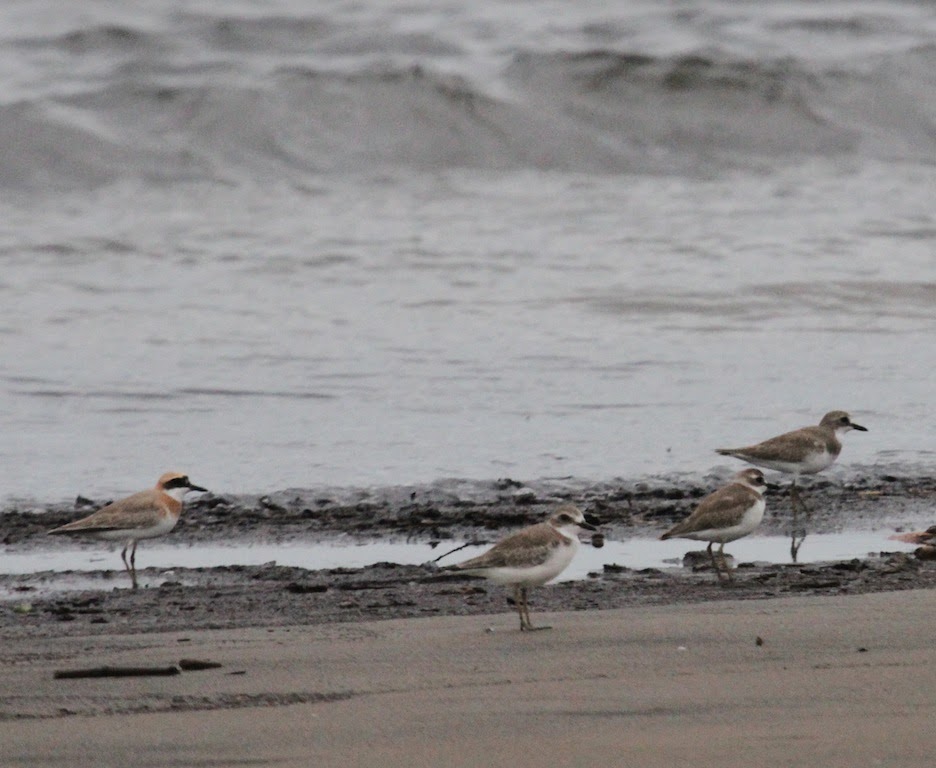


Around 50 lesser sand plovers remain at Coquette Point and a few are in breeding plumage. No doubt they will soon depart as lesser sand plovers do not breed in Australia.  Their migratory route will take them to China, the Korean Peninsula and eastern Siberia. They will return, with their offspring, in September.


On the outer most sandbank I saw whimbrels fishing with a few crested terns. The whimbrels will also be departing soon as they breed in the subarctic of North America and Europe.

No sightings of little terns, godwits, tattlers or Pacific plovers it appears they have already left on their migratory journey.


However the pied-oyster catcher do breed on the sand-dunes of their territorial beach. Dogs are the biggest problem for resident breeding birds like the pied oyster catcher and the beach-stone curlew, both nest on or behind the sand dunes.

Dogs often disturb and chase these birds and when the nesting bird is away from her eggs for some time the eggs become overheated in the sun and the small chicks within the egg, cook.

That is why it is important, for the survival of shore-birds, to make some beaches no dog zones.


Pied Imperial Pigeons have been congregating at Coquette Point in a flock of about 70 birds.
Soon they will depart for Papua and Indonesia.  The whole flock were in a flowering quandong Elaeocarpus eumundi tree this afternoon and as I walked underneath to get a photo they lifted off through the top of the canopy, magically manoeuvring their strong wings through the leaves and branches.


                   The metallic starlings have been particularly noisy this week and juvenile birds have been demanding food on the wing. I have not noticed this before, normally when the metallic starling chicks fledge they are shown how and where to feed by the parents. Perhaps the heavy rain has changed the normal feeding pattern?


Cassowary chick Ky is having no problems with finding food. Snout is constantly on the move visiting the fruiting trees two or three times a day.

The bandicoot berry, Leea indices' fruits are ripe and snout picks at them until many fall to the ground where Ky can feed.

The fruits of the Leichhardt tree, Nauclea orientalis are falling and the cassowaries search for fallen fruits around the these trees every morning and afternoon.


Jessie does not have to be so careful and she eats the Leichhardt fruits in
such a hurry they mount up in her throat.


I watched Jessie one afternoon as she strode down the road in a hurry. She turned quickly, crossed the gutter and with a mighty jump plucked a ripe guava from a tree.


 Later I watched her scramble down a steep bank, jump the gutter and dive into the rainforest. She purposely journeyed to each tree, harvested the ripe fruit and then went on her way. Food was on her mind and there was no stopping her.


I saw a young cassowary this week, about four or five years old. He was near Manayard Road and I could not identify him. He disappeared into the rainforest before I could get good photos. He is most likely one of the seven chicks from 2010.

About 100  red-tailed black cockatoos are flying to the Johnstone River estuary every morning. This week they have been mainly feeding on the paperbark trees, Melaleuca leucadendra. They appear to be feeding on the seeds and they do so with a great deal of noise and squabbling.


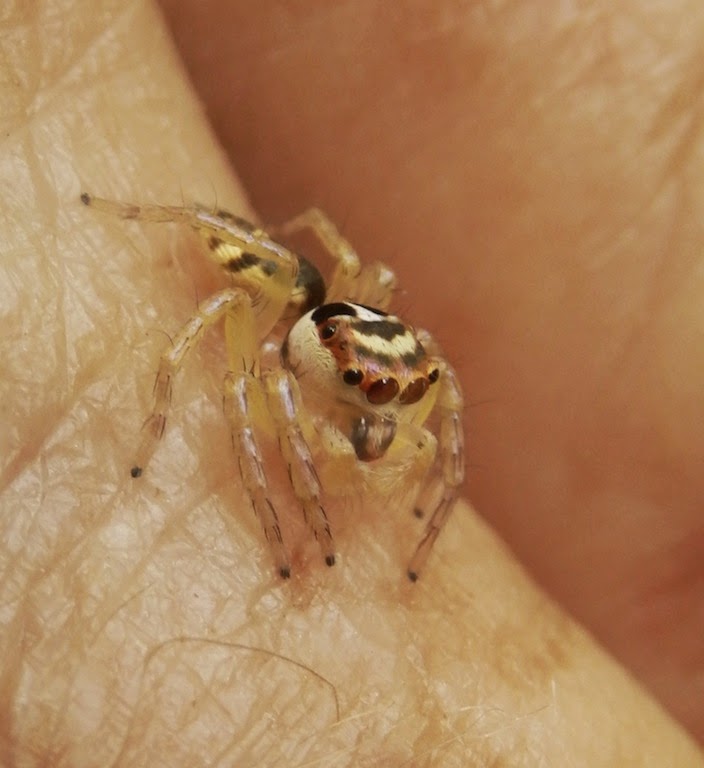
I photographed another jumping
spider species at Coquette Point this week and I sent the photo down to Robert Whyte at the Queensland Museum to identify. Robert advised that this jumping spider " is a well-known but un-named Euryattus sp. It is documented thoroughly by Robert Jackson from NZ who studies behaviour. He documented the signalling during courtship. They wave the first two legs in rather geometric poses like someone signalling semaphore." You can see the spider doing this in the right hand photo above. However, I did not see a female but I was very impressed with his peculiar behaviour. I picked him up and put him on my hand to get a better look and noticed he had a mite on his jaw.  I have seen mites on dragonflies and stick insects but never before on a jumping spider.

I also sent Robert a photo of another spider I could not identify.

Robert advised it is a golden orb weaver, 'but a rather unusually coloured one'.


Since the rain started the bird-wing butterflies have gone into a frenzy of egg laying. The wet weather must stimulate them into action.

The caterpillars from the last egg laying session are fully engorged and should form into their pupa stage shortly.


Ulysses butterflies are also very active at the moment. It is always a marvel to glimpse their iridescent blue flying across the bright green rainforest canopy: butterflies are one of nature's special gifts.


 If you can make it on Thursday 27 around 4pm at the nursery to celebrate the launch of the 3rd edition of Tropical Food Gardening and a feast of tropical food with 'Taste Paradise' you are most welcome. It is BYO drinks.

I hope you are getting some rain at your place.

cheers,
Yvonne