Saturday, 8 December 2012

Hello from hot and humid Coquette Point,

Summer has well and truly arrived and the few mils of rain have not been enough to crack the dusty soil surface. The creeks are running low and the rainforest is thirsty.

 
On Wednesday 5th frog ecologist Deborah Pergolotti www.fdrproject.org.au and Russell Constable http://ellabayforever.blogspot.com  and I got together to see what frogs were active at this dry time of the year. We planned to do a frog survey at Ella Bay. Ella Bay is on the northern side of the Johnstone River, north of Flying Fish Point and only two kilometres, as the crow flies, from Coquette Point.
Ella Bay, as you may know is where a proposed mega development of a gated community, integrated with three tourist resorts precincts, is planned to be built. The development proposal is for a self contained community with shopping village, golf course, activity centre and so on. It is planned to house some 5000 'demographically mega-rich' and provide for up to 2000 'up market' tourists.  All this in 470 hectares of , unused agricultural land, which sits as an island surrounded by World Heritage estates: adjoining on three sides with World Heritage Wet Tropics and fronting Ella Bay which is part of the World Heritage Great Barrier Reef.

We drove down the narrow, unsealed road which runs through dense, littoral rainforest.
At times the road dips down to run behind the beach dune-line before diving into the rainforest to avoid a gully and then back close to the beach. Numerous rainforest streams run under the road and it was these streams we intended to explore during the night.
 
This time we had been given permission to walk through the gate in order to access the beach.
On the 20 November 2012 I was locked out of Ella Bay after I had been first invited to join an ABC  camera team who were doing a story on Ella Bay. However, Ella Bay Pty Ltd would not let me enter the property. The photo above shows the gate locked in front of me. 
 
With verbal permission to hand we walked down onto the beach and immediately saw cassowary footprints in the sand.
Cassowaries favour a mosaic of forest types including mangroves and beaches. At Coquette Point I have often seen cassowaries fishing for soldier crabs on the beach.
We saw numerous cassowary footprints on
the beach at Ella Bay, evidence of the large population, over 15, of these birds in this area.
Only yesterday I was sent a video of three new chicks born to one of the Ella Bay/ Seymour Range cassowaries.
 
Deb sung out when she found the shell of a turtle egg. Turtles come up onto the beach at Ella Bay
and build their nests in the dune-line behind
the beach. Paperbark and casuarina trees stretch their shady, gnarled branches over the beach,  
an idyllic environment for turtles.
A high pitched buzz filled the air and we went in search of its source. We found a green whizzer cicada announcing his presence to any females in the area.
 
As we walked we looked out into the bay
aboriginal elder Nellie Epong told me to look for the Indo-Pacific humpback dolphins as they used the protected waters of Ella Bay as a nursery and she told me you can often see the parents, in the bay, coxing the young dolphins. Unfortunately they were nowhere to be seen on Wednesday. 
 
As the sun set across the bay we walked back under the tall littoral forest which runs behind the beach. We heard and saw spectacled flying-foxes and Deb was sure she heard the rare and threatened ghost bat. Certainly there was a lot of activity as the bats moved in for a nights feasting.
 
Russell was first to find saw-shelled turtles swimming in the rainforest stream.
 We decided to have dinner at the Flying Fish
Point shop: they are famous for their fish, chips and salad and they didn't let us down.
Dinner finished we returned to the rainforest and quickly ventured into the first little creek.
 
 We walked about 500metres climbing under orb spider's amazing golden web which was stretched from one side of the creek to the other.
Russell, who was walking ahead called out
he had found a scorpion Liocheles sp., we waited while he photographed it.
We heard and soon found the little
green-eyed tree frog Litoria serrata  and managed one photo before it jumped away.
We walked as far as we could and then ventured into the next stream.
Jungle perch swam around our gum boots
and sleeping on a rock we found the beautiful Morelia spilota cheynei, unperturbed by our presence.
The bright eyes of prawns and yabbies glowed in the light of the torches. These little streams were
very productive and up stream of the road we found them still in their natural state.
Then all around us we heard the loud
'wreek wreeks' of the endangered common mistfrog Litoria rheocola. Russell took a video of L. rhecocola and has posted it on http://www.youtube.com/watch?v=xEg7b6aZd5I
 
We had gone as far up stream as we could and turned to go back happy we had found L rheocola.
 
Approval of the Ella Bay development now rests with the federal environment minister the Hon Tony Burke. You can write to him directly or click on the link to http://ellabayforever.blogspot.com  and sign the petition to help protect Ella Bay.
 
cheers for now,
Yvonne.


Saturday, 1 December 2012


Hello from Coquette Point,

Today we welcomed in the first day of summer under a refreshing tropical shower. This washed the dust from the leaves in the rainforest and when only yesterday the leaves were all droopy today they are stretching their shining clean surfaces to the sun. What a difference a shower of rain makes after a month of dry weather.

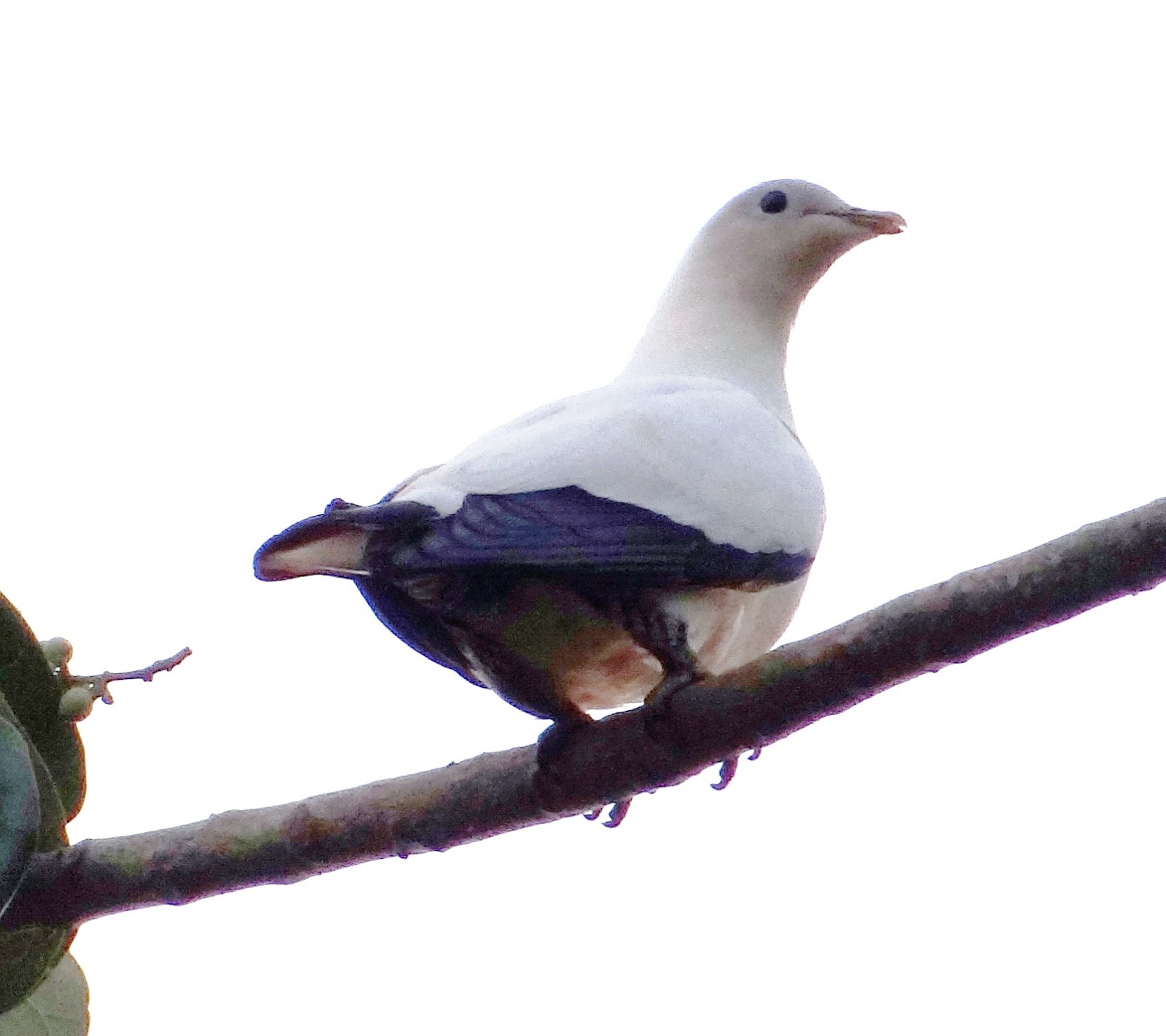
In the rainforest the thick early morning air is humming with a chorus of coos from the pied imperial pigeons. They stir from sleep as the sun's first rays reach them and the cooing, fluttering and whooshing of their wings rises to a crescendo as the pigeons greet the new day.
Suddenly it's time to preen and in the nesting area the canopy of the trees starts to vibrate with movement and sound as the pied imperial pigeons preform their morning ablutions.
Ahhh...  a good scratch behind the ear.
Clean under the left wing then under the right.
Not a feather is left untended.
Another chorus of coos signal they are 
ready to leave for a day of feasting on the fruits of the Moresby Range National Park.
 
A swarm of Christmas beetles have emerged and they are feasting on the lush new growth of the
rainforest canopy.
When the Christmas beetle  finish feasting they hide deep down in the foliage of the trees and sometimes congregrate in large numbers such they can completely cover the  trunks and branches of their host trees.
I found this Christmas beetle sleeping in
the heart of a Licuala palm.                                                                     
 
                                                                                                     
Disturbed the beetle quickly crawled to the top. 
 As the beetle approached the edge of the palm frond it started to wave small, clubbed antennae.
The Christmas beetle raised up on strong
prickly legs and stepped over the edge of the leaf and tumbled to the ground.
As the beetle tumbled to the ground
 the clubbed antenna splayed into three and when the beetle landed it quickly buried itself into the leaf -litter. I thought how strange! I found more Christmas beetles hidden in the palms and when I disturbed them they all raced to the top of the frond and tumbled to the ground.
Christmas beetle larvae pupate in the ground and feed on the roots of grasses and trees.
I asked Dr Bill Farmsworth a local entomologist about this strange behaviour and he advised
that tumbling was a common defence mechanism of many insects.
 
However, the beetles have little defence against the sticky web of a garden orb-weaver spider.
Very early one morning, 5.30am, as the
sun cracked above the horizon, I saw a beetle fly into the clutches of garden orb-weaver's web.
Within seconds garden orb-weaver covered beetle
in a sticky gossamer shroud.                                       
The beetle was completely immobile firmly
held in spider-silk.
Only then did garden orb-weaver mount
the beetle ready for the kill.                                                                 
Garden orb-weaver's fangs descended into the   beetle to complete the kill.
 Garden orb-weaver spiders spin their web at night and remove them at the first light of morning.
 
In the hot summer weather spiders are very active in the rainforest and particularly my favourite
the salticidae or jumping spider. Following are the jumping spiders I saw this week.
                                                                           
                                                                           
Sensing hairs can be seen on the head and abdomen of this salticidae.
 
                                                                          
                                                                                   There are over three hundred species of salticidae in Australia.                                                                                                                                               
This salicidae is very large about 3 cm.
                                                                           
                                                                               
The cassowaries are feeding on a glut of wax jambu.
Jessie tolerates Snout for a few minutes, it is time to keep clear as she now chases him away with angry hoots.
If Biggles sees Jessie he runs and hides in the mangroves.
 
I think Biggles thought I could not see him
as he hid his face behind the thin trunk of a mangrove and occasionally glanced out at me.  Cassowaries are weird and marvellous ancient birds. 
 
I had the pleasure of helping St Rita's school teacher, April Johnson this week. April is creating a project for the children of her class to learn the craft of painting collage of rainforest scenes with bark and seeds of rainforest trees. I walked into the forest with April collecting bark from for her project. We collected bark from melaleuca, red beech, kauri pine and wattle trees.
 I hope April posts some photos of her students work.
Cheers for now,
Yvonne C.


Saturday, 24 November 2012

Hello from the beach at Coquette Point,

Sunrise is the best time of the day. Not only is it cooler, a welcome relief at this time of the year, it is the time when shore-birds are most active.
As the sun's light slowly lifts the shadows from the beach the shore-birds appear. They arrive as if from nowhere, some flying low in over the water, others descending from the sky and yet others arrive in a run from the sand dunes behind the beach.

A grey-tailed tattler and a common sandpiper  appeared on the dead stump of a tree. The bird's shadows were reflected in a pool of water. The black stump shaped like a giant crocodile about to leap and eat the tattler. Also reflected in the water the dead trunks of the old mangrove forest, they appeared to ascend from the waters dark, depth like legs of long, lost souls.
 Only at the very beginning of the day can you find this magic.


A rainbow bee-eater sat on the branch of a leafless mangrove, her head lifted to the sky, the sun bathing her chest.


She sprung into the air and snap, snap. A swarm of  bees searching for nectar became rainbow bee-eaters breakfast. She had been waiting in ambush, not sunbathing.

 The female bee-eater's two central tail feathers are shorter than the males.


I walked back to the nursery and saw, in a clearing, cassowary Jessie stretching her body to full height in dominance. Snout was drumming in distress, Jessie has fallen out of love.

Poor Biggles, the territorial disputes are on and he is last in the pecking order: chased by Jessie, Snout and Dot. However, he seems to have made up his mind he wants to stay here and I see him every few days somewhere around the Point.
 
 When Dot turned up they were amazed.  Curly and Siri from Mele Village, Vanuatu I hope you enjoy your stay in North Queensland and have lots of stories to tell about our big birds.
I was lucky this week to see the new chicks.
I was able to identify the cassowary dad as 'Brown Cone'.  Unfortunately one of the chicks was hidden by the long grass and when I approached to get a closer shot, they disappeared into the rain forest.
I was really excited when coming home from town on Monday, walking across the road near the Ninds Creek Bridge was a cassowary I had never seen before, a female I think. Her wattles are quite long so she must be a good age. Perhaps she is    'Brown Cones' mate as he hangs out in this area.
She disappeared quickly into the mangroves
on the western side of the bridge. I will ask around if anyone knows this bird and if they have a name for her?
The hot weather has triggered the praying
mantis into egg-laying. I found this female almost finished her task at 6.30 in the morning.
 
As I watched she withdrew her ovipositor from
the egg-sack, (ootheca), and climbed a little way up the stalk she had used to attached the ootheca.
She remained in that position for the rest of the day, her forelimbs drawn up close to her chest. No doubt exhausted by the ordeal of egg-laying she needed time to regain her strength and she was also guarding the oothera until it had hardened. What a privilege it is to observe these amazing creatures. The next morning she was gone.
Every day the osprey catches a fish or two.
They bring the catch back to the nest tree and slowly consume their meal.
Underneath the osprey nest bush-stone curlew
has hatched two chicks. Unfortunately they were hidden in the grass and I did not get a photo.
The first of the metallic starling babies have hatched
and the parents are busy tending to them. Above the female removes soil from the nest while Dad looks on.
While some starlings engage in courtship.
over completed nests.
some younger birds dry themselves
following a bath.                                                                                                                    
before trying to work out how to build a nest.
Note the fruits of the white apple are maturing and soon the metallic starlings will be able to eat at home.
In the rain forest the nectar laden  
 flowers of Darlingia darlingiana paint a white, lacy canopy alive with thousands of bees.
TThe flowers and new spring leaves of the canopy
are an ever changing mosaic of colour.
The cream brushes of Grevellia baileyana are in flower
on the edge of the rainforest.                                        
Concealed under the canopy are the blossoms
of the satinash. The flower heads appear on the trunk and branches of this tree.
 
On the edge of the mangrove forest, the pale blue
flowers of the holly-leaved mangrove, Acanthus ilicifolius, give a glow to the dim shades of the forests floor.
While sun, heat and rain provide the
energy for the forest to grow new leaves. Insects, like the stick insect above, are busy stripping the foliage from the new growth.
Eileen was fascinated when this large stick
insect jumped out of a plant she was looking out and made itself at home on her arm.
Stick insects chew succulent, summer leaf growth forcing the plant to grow into a compact shape.
In the measure of things there is a roll for all creatures.
 
cheers from Coquette Point.
Yvonne c.


I heard the cooing of Pied Imperial Pigeons and saw them sunning themselves in the top of the trees. They were about to leave to gather the fruit from the canopy of the rainforest of the Moresby Range National Park.