Donny Grey and Jim's son Ruben have just phoned me and told me that Jim Wertz died from a heart attack last night. Apparently Jim was experiencing chest pains and phoned Alan Carl who together with Ruben were taking Jim to hospital when Jim experience a massive heart attack. Ruben's wife, who was with them, is a doctor but Jim did not respond to CPR.
Those of us who knew Jim understood that under all the uncouth bluster and misogyny there was an intelligent man who was willing to be a friend.
I first met Jim around 1980 when Anne Martin, who was writing for Family Circle magazine at the time, dragged me along with her to Mossman where she was interviewing Diana Cilento as well as Diana's neighbour who was said to be 'a wild man who lived in a bamboo house in the rainforest'.
Jim was an American and he came to Australia as a young man and worked for the Queensland Museum for many years before moving to Mossman. He was a bit of an expert on Australian reptiles.
That was thirty years ago but somehow Jim always kept in touch. In recent times he had made good use of the Internet and if you were on his mailing list you would have enjoyed the flood of political comment and satire. Our thoughts are with you Ruben and Jessica. We will miss you Jim.
An abundance of fruit on the trees in the rain forest is providing a feast for many birds. It is interesting to watch the interaction between the birds. The nutmeg pigeons fly in and plop down on their favourite feeding tree, the native olive Chionanthus ramiflorus and within a few minutes the cassowaries arrive. For every olive the pigeons eat they knock off two. Plop, plop they fall to the ground easy pickings for the cassowaries who without the pigeons would have no hope of getting succulent fresh olives from high up in the olive tree's branches.
 Pigeon surveys at a feast of fruit.
Pigeons throw themselves against the tree.

 From a distance the tree appears capped in snow.
Dot waits for the olives to fall.

 Many of the olives fell into the gutter so Dot climbed in.
There is a similar relationship between the metallic starlings and the emerald doves.
The starlings arrive to feast on the macaranga seed which is contained in a green capsule. They pop open the green pods and spill some of the seed.

 Emerald dove finds the fallen macaranga seed.
Snout looks back to see if Jessie is following.

On Monday I saw Jessie once again following Snout.
Again on Thursday I saw them together and this time they were walking through the cleared land on 27V ( the proposed RV development site).

Snout knew where he was going and as I watched I saw Jessie stretch and jump to pick the fruit that he had taken her to.
 When they finished eating they walked away
into the forest on the eastern side of the property adjacent to the Wet Tropics boundary.

A large agile wallaby watched the cassowaries as they crossed 27V.
Russell phoned me on Wednesday and said he had seen Little Terns at Cowley Beach. I had not seen them here this year so I went for a walk around to the front beach to look on Thursday.
My old gardening friend Ross was there and his mate pelican was by his side. The pelicans have just returned to the coast from central Australia following the drying of Lake Eyre. Ross put out three lines and as soon as a fish took the bait pelican rushed over to the line. Ross said the pelican never ate his bait- fish but when he cleans and heads the fish pelican eats it up from the sand. The pelican sat beside Ross for three hours. When Ross left pelican walked up to me as if asking 'are you going to fish?'
 Ross and his mate.
Pelican got excited as Ross pulled in a fish.

 Pelican looked at me as if to ask, "Will you go fishing?"
Ross told me about people who brought dogs onto the beach and let them run wild. "They chase and worry the shore birds". Ross told me. Apparently when Ross asked one man, known to him, to restrain his dog the man threatened Ross. The same man abused Bill F, over a similar incident, a few months ago and I was witness on that occasion.
I walked further around the beach and there was another man walking an unrestrained dog. As I watched the dog ran toward the rookery chasing birds. The man called the dog to heel and the dog obeyed, however, the birds took flight.


Lots of migratory waders had arrived and every where I looked there were groups of birds busily feeding.
 The wood sandpipers fly to our shore all the way from the Northern Hemisphere.
 Whiskered terns feeding with crested terns.
Grey-tailed tattler waits for a movement.

 Tiny sanderlings darted to and fro.
A wandering tattler has a pond to himself.

 Whimbrels were fishing in the shallows.
 The waders where everywhere on the flats.
As I walked back the whiskered terns flew overhead and started fishing in the Johnstone River
estuary.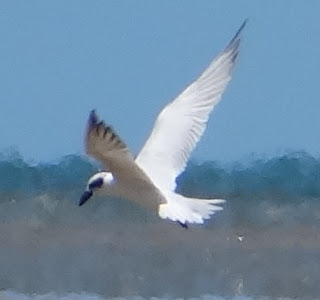

 When I entered the mangrove forest I heard a female shining flycatcher singing joyfully in praise of the day.
A male varied thriller was chatting with his mate.


Dusky honey-eaters darted in and out of the trees in much excitement.
.JPG)
 I spoke to Damon Sydes at CCRC this week and he has replaced the stroke through the dog sign at Coquette Point. Let us hope that it is not vandalised again. The Wet Tropics sign has not been replaced.
The cat birds are courting and vocalising together. Their calls are extraordinary as they answer each other in meows and snarls before they set to chase each other through the mangroves..

Only pheasant coucal is louder than the cat birds and early one morning as I was turning the pump on a large, most possibly female, coucal starting calling from a nearby melaleuca tree. She puffed up her chest until it almost covered her face and it looked like a giant black beard.
 The female pheasant coucal is larger than the male and it is he who incubates the eggs. These coucals make a nest of their own in reeds and do not lay their eggs in other birds nests.
Potter wasp finished constructing the first thermal layer on her nest last Sunday. Potter wasp used three different coloured clays in the construction and then added moss to the finish. The nest was camouflaged against the tree. Fine weather all week allowed the clay forming the nest to dry.
 Potter wasp used different coloured clays.
Potter wasp completed thermal layer and decorated nest with moss.

There was no sign of potter wasp around the nest for five days. On Thursday morning she returned and started to construct a second thermal layer. This time the gap was less than half a millimetre.

When this layer was completed she decorated the nest with a 'stucko' finish.

.Each time she left to gather her clay she again visited the bromeliad cup to suck up water to help her form the clay ball.

On several occasions I have glimpsed a very small fly follow potter wasp back to the nest. The small fly keeps out of her way often landing on the tree trunk above the nest. I managed to get a photo of the fly this afternoon, however, I have not seen it land on the nest. It is so small, about one millimetre, I possibly would not see it.

This afternoon potter wasp put the finishing touches to the nest.
 Potter wasp's nest is completed.
That's a wrap from Coquette Point.
cheers, Yvonne.


