Saturday, 15 March 2014

Hello from Coquette Point,

This morning we woke to a blue-sky-day with a touch of winter in the air, the clouds and rain of the past week had evaporated, it has been a perfect day on the Cassowary Coast.

As soon as the wind dropped this week the fishing boats all rushed to sea busy to gain a catch of fish for the Easter Market. Only the memory of cyclonic winds remained in the clouds and a long low swell in the sea gently set the boats rolling as they left the river mouth.


Cassowary chick little Ky had enough of the rain and when dad Snout sat down she tunnelled into his feathers to find shelter from the rain and protection from the incessant mosquitoes.

Sometimes Ky almost disappeared entirely under Snout's thick feathers.


I was sitting down this morning having a cup of tea with a friend when we heard cassowaries drumming. We ran to the sound and saw that matriarch cassowary Jessie had turned up and Snout was not at all happy.

Jessie showed no aggression towards Snout or Ky and in fact lowered her head submissively.

When little Ky walked towards Jessie, no doubt anxious to meet his mother, Snout uttered a low growl. The sound was something between a dog's snarl and a loud expulsion of air like a 'fart'. Three times Ky approached Jessie and each time Snout uttered this same sound. A sound I have never heard from a cassowary before. Each time it resulted in little Ky running away from Jessie. Jessie made no audible sound nor did she show any aggression to Snout or Ky.


Eventually Jessie left and Snout and Ky, very much on their guard and nervous, walked down to the Cherry Guava tree in the nursery for a snack.


The male satin fly-catcher was very active in the warm sun today. Jumping from branch to branch in the mangroves he hungrily fed on the numerous insects of the mangrove forest: there was no sign of the female satin fly-catcher.


I saw a helmeted friar bird acting strangely in the melaleucas. Suddenly he jumped, caught a cicada and swallowed it whole.

Although helmeted friar birds mostly feed on the rich nectar of flowers or enjoy a feast of ripe fruit, these ungainly birds are also capable insect hunters.


The black cockatoos flew into the melaleucas tree-tops today. The flowers have turned brown and the remaining nectar has fermented in the hot sun. The cockatoos jostled in the melaleuca's canopy to take possession of the best flowers and drink their toddy.

When they finished they feasted on the ripe fruits of the beach almond, Terminalia catappa.  Mosquitoes covered me as I stood in the mangroves photographing the birds and I noticed the cockatoos also scratching the insects away from their face.


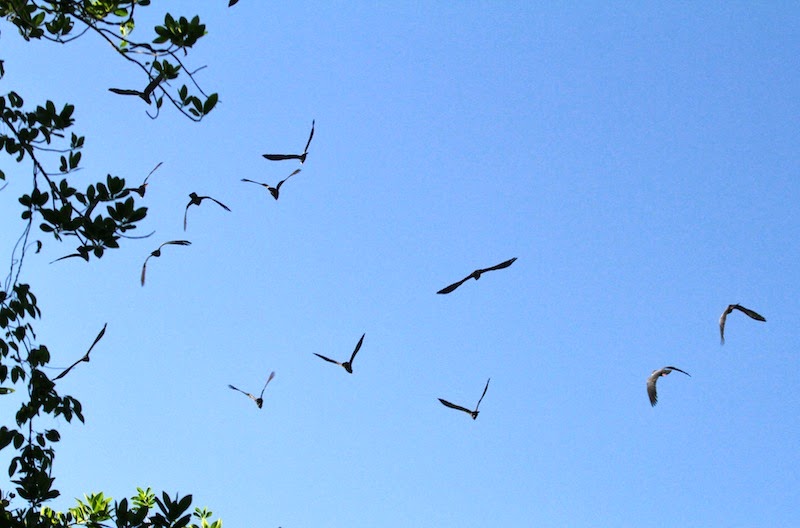
Soon they finished eating and drinking and swept from the tree tops and headed to town.


Underneath the trees the sand dune was littered with fallen beach almond fruits which the cockatoos had knocked from the branches. I had no doubt the cassowaries would arrive soon to feast on the fallen fruits.

News from around the traps:
Hazel Holland lives across the Johnstone River from me at Flying Fish Point and the cockatoos have been dropping into her front yard to feast on the fruits of her beach almond tree. They have been eating the fruit from the canopy as well as the fallen fruit under the tree.


The fruits of the beach almond are eaten by  fawn-footed melomys, white-tailed rats, flying foxes as well as cockatoos and cassowaries .


Hazel had a special visitor to her garden this week and sent me this photo to share with you.

Hazel told me she heard a noise outside her kitchen window and when she looked she found an echidna in her garden bed; what a wonderful photo Hazel took of this special creature.

Echidnas are out and about at the moment and many are killed by speeding cars when they try to  cross roads.
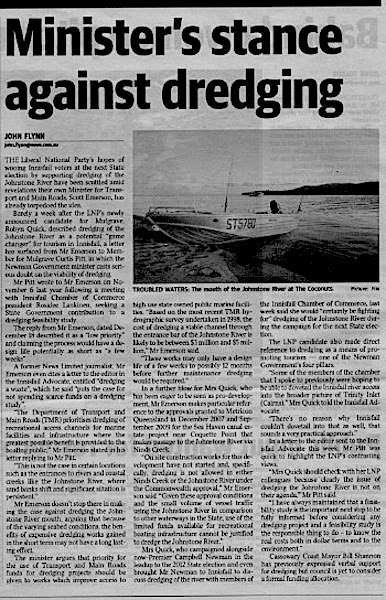

It is reported in today's Innisfail Advocate that the State Minister for Transport and Main Roads, Scott Emerson states he does not support funding the dredging operations on the Johnstone River bar.

Mr Emerson states " These works may only have a design life of a few weeks to possibly 12 months before further maintenance dredging would be required."

When you look at the history of dredging of the Johnstone Bar that is exactly what has occurred, not once but dozen of times in the past until the old Johnstone Shire Council, in every previous occurrence, gave up, as it was far too costly to continue dredging a channel through a shifting river-mouth bar.

The previous Labor Government supported dredging of the Johnstone River and perhaps it is an indication of why they got our State into an 80 billion dollar debt hole.

As Mr Emerson has stated, "Funds need to be spent where the greatest possible benefit is provided to the boating public."

Mr Emerson made particular reference to the approvals granted to Metricon Queensland for the Sea Haven canal estate project near Coquette Point that makes passage to the Johnstone River via Ninds Creek. "On site construction works for this development have not started and, specifically, dredging is not allowed in either Ninds Creek or the Johnstone River under the Commonwealth approval," Mr Emerson said. "Given these approval conditions and the small volume of vessel traffic using the Johnstone River in comparison to other waterways in the State, use of the limited funds available for recreational boating infrastructure cannot be justified to dredge the Johnstone River."

I may not agree with all the policies of the Queensland Liberal National Party Government, however, as an economic rationalists myself, I know that strigent cost benefits analysis must be carried out on all Government projects.

Enough of politics:  If you are able, please join me at Coquette Point on Thursday 27th March at 4pm for the launch of the third edition of 'Tropical Food Gardening'. www.tropicalfoodgardening.com

Cheers for this week,

Yvonne


Saturday, 8 March 2014

Hello from the Wet Tropics of Coquette Point,

Tonight we are watching Tropical Cyclone Gillian now in the Gulf of Carpentaria 265 kilometres west of Thursday Island and moving east southeast at 12 kilometres per hour towards the coast.  Another system  is slowly intensifying and may develop into a tropical cyclone on Sunday.  It is an extremely rare event to have two cyclonic systems about to impact the Queensland coastline at virtually the same time. These two circulations will make meteorological history and time will reveal their impact on  Queensland.  The models differ in where these systems actually will make landfall. Whichever way, they are not expected to build into severe cyclones.  However, we will experience gale force winds and very heavy rainfall along the coast over the next few days. Unfortunately this rain is not expected to penetrate into the drought affected areas of western Queensland.  The map shows the possible position of the lows late on Sunday.              
                                                                                                                 
The outflow of high cloud from these monsoonal systems is creating spectacular sunsets and the light displays are continuing well into twilight. The photo below was taken at 7pm Friday evening, low tide, on the banks of the Johnstone River. The old derrick from the Dvorak wharf can be seen on the left.


All this week we have experienced strong wind as the large high in the Bight combined with the low pressure of the monsoon trough combined to create a strong ridge along the Queensland coast.

The strong winds splayed cassowary Rosie's feathers exposing a bare bottom, but did not stop her feeding on Panama berries.

Matriarch cassowary Jessie strode through the orchard on Monday. The last time I saw her was late January and there were no reports of sightings of her in February. It is normal for Jessie to disappear for a month or two each year, during this time she remains somewhere deep inside the Moresby Range National Park. Hopefully, she is enchanting some of the young male cassowaries that have not been sighted for months such as Q, Dot, Stumpy and Captain Starlight. This week Jessie has been seen at the western end of Coquette Point, near the Ninds Creek bridge in the early morning and by lunch time she has been seen at the top of the Moresby Range. Cassowaries can move long distances in a very short time.


I watched Jessie as she stopped to rest under the Wax Jambu tree. She was covered in mosquitoes and shook her head, twisting her neck seemingly like a corkscrew.  When mosquitoes bother Snout he picks them off one at a time.
So when I saw little Ky using the same method of removing mosquitoes as Jessie one must ask, has she inherited this habit? Although Ky has seen Jessie in passing she is solely cared for by her father Snout and would not have picked up behaviour from Jessie. It is fascinating to watch the personality characterists of cassowaries and their offspring.


Cassowary Snout has been spending a lot of time in the mangroves this week and he turned up with Ky to feed on the strawberry guava yesterday and with very muddy feet.

With all the rain mosquitoes numbers are increasing. Three cases of Dengue Fever have been recorded in  Marty Street East Innisfail and the Council has been fogging in the area.

Spiders and dragonflies are doing their best to consume these insets but really we need to look at breeding sites and clean up our own yards.

The mosquito which carries the Dengue virus, Aedes aegypti, does not breed in outdoor bush areas. This mosquito favours water lying around and in the house. If we cleaned up our house and yards we would eliminate all breeding sites and eliminate the Dengue virus.

Severe Dengue Fever can be life threatening.


I have been watching a praying mantis egg case, ootheca, for over a month now, hoping to see the nymphs emerging. It all happened Monday morning but I was an hour too late and they were crowding the tips of the palm fronds when I checked out the ootheca around 8am. One nymph was still on the ootheca but it quickly scurried to join the others.

Hundreds of mantises nymphs covered the blades of the palm frond.


As I watched a jumping spider appeared, it was a small Zenodorus orbiculatus. He ran along the palm frond and jumped at a nymph and missed, he jumped again and missed again. On the third pounce he landed on a mantis nymph and grasped it by the tail and proceeded to consume the struggling baby insect.


Soon Z. Orbiculatus was joined by a large  Opisthoncus polyphemus which captured a nymph in the first jump, but it was a bit easier as this nymph was sitting on a larger leaf.

The jumping spiders ate only one nymph each then disappeared. Several hours later I returned to check on the nymphs.


I found Mr and Mrs Mopsus mormon with very satisfied looks on their little faces. There still seemed to be hundreds of Mantis nymphs on the palm fronds and other plants.


Female left, male above.


    On the same afternoon I saw a male Cosmophasis micas, above left and two other very small jumping spiders, unidentified, about 1mm.,  they could be juveniles.


There was no sight of any of the Mantis nymphs the next morning.


Large flocks of Shining starlings venture from their nest tree every day to forage in the rainforest. The juveniles are all confident flyers now, however a few adult birds always accompany the juveniles and seem to be instructing and watching over them.


The viviparous purple fruits of the river mangrove Aegiceras comiculatum are ripe and ready to fall. The white flowers of this mangrove are scented and an important source of nectar for native and exotic honey bees. These mangrove fruits were eaten by Aboriginal people after baking, boiling in several changes of water then baking again.

Characteristic of the river mangrove is the large deposits of salt crystals on the leaves.


The fruits of the grey mangrove Avicennia marina are falling into the river and at high tide they are washed up on the tide-line and are easy to collect. When the ripe fruit falls they contain a single seed which opens to reveal two green fleshy, folded cotyledons or seed-leaves. These fruits were an important Aboriginal food. If you collect the seed  remove the bitter petiole, boil the seed for about half an hour in several changes of salt water. The boiled seed is a little like unripe avocado.
                                                                                 

The paperbark swamps of Coquette Point are in bloom. The Melaleuca leucadendra trees of the swamps are dripping with nectar and the air at Coquette Point is heavy with the burnt caramel perfume of the flowers. At sunset the spectacled flying foxes are arriving in their hundreds and all night their squabbles can be heard as they jostle for possession of the flowers. In fact I can hear them now fighting and squawking. Mosquitoes and drizzling rain have kept me and the camera indoors, so sorry no photos of the flying foxes.
Aboriginal people made a sweet drink from the paperbark flower's nectar.  Collect a billycan full of flowers and cover them with warm water. Allow to steep for half an hour, shaking occasionally. Pour off the sweet water and drink.


In every pond toads are mating and laying eggs. I have not seen so many toads around for years.  The extended wet weather has created the perfect breeding conditions for these pesky creatures.


Our Ruth Lipscombe, who surveys all from her home at the top of the Moresby Range which overlooks the Johnstone River estuary told me.  "One of the delights of living at Coquette Point is being able to watch the constantly changing patterns on the water as the rain squalls sweep across the Coral Sea.
             The initial sound of raindrops on water is quickly followed by the thunderous noise so many of us love-Bill Scott's tropical Rain on the roof."

Thank you for that beautiful description of the Monsoon Season Ruth and happy International Women's Day to you and all the wonderful women of our Community.

Cheers and keep safe at home and on the road with the extreme weather expected this week in FNQ.

Yvonne