Saturday, 15 November 2014

Hello from Coquette Point,

I had a great thrill this week when I was able to cross off another bird, I had not previously seen, from Billie Gill's 1970 list of birds of the Wet Tropics. This list included a bird count for Coquette Point.

This little bird that I saw for the first time, but Billie had sighted in 1966 was a Terek sandpiper. Many shorebirds can be difficult to identify but the Terek sandpiper is the only small shorebird with an upturned beak, in addition its legs are orange and the colour stands out contrasting with the other shorebirds.

Left: Terek sandpiper with a grey-tailed tattler in the background near the mangroves. This week I counted four Terek sandpipers spread over a large area of the estuary.


Left Terek sandpiper. Above Terek sandpiper, grey-tailed tattler and common sandpiper.


Below a Bar-tailed godwit fishing on the beach-front with a Terek sandpiper foreground.

The grey-tailed tattlers were quarrelling again this week and this time in the mangroves within the Johnstone River. I was able to get close to take photographs, safely concealed by mangroves and not noticed by the birds as they were completely engrossed with the fight.

The referee was Common sandpiper and the judge Whimbrel.

Judge Whimbrel read the Marquess of Queensberry rules to the boxers and referee.

The boxers are assigned to their corners and the referee, common sandpiper goes to one side.
 The fight begins with the one tattler aggressively abusing the other.


Left: The tattlers decided to take the fight to another venue and both took to the air.


Common sandpiper made a quick exit from the ring and flew behind Whimbrel where they watched the aerial battle from the ground.

Unfortunately I was not quick enough to  capture the aerial fight from my mangrove hideaway but it did not last long when one tattler left to feed on the front beach while the other had the mangroves to himself.


Life is full of excitement along the mangrove covered banks of the Johnstone River.


I have not seen the blue soldier crabs emerge in mass, as yet, and that is unusual, normally at this time of the year there are thousands of them running on the sand flats at low tide.

However, the stalk-eyed crabs are mating and males are engaged in territorial battles across the beaches at low tide.


The first of the eastern curlews have arrived from their Siberian migration with only two birds seen at Coquette Point, to date. Normally at this time of year there are many more of these majestic birds feeding at Coquette Point. The eastern curlew is listed as Near Threatened in Queensland.


The beach stone curlews appear to have moved to the dune area where pied oyster catcher patrols. They seem happy enough as they pass each other and I have not witnessed any squabbles. Early in the morning beach stone curlew is only interested in having a good preen and watching the greater sand plovers as they race each other along the beach.


The red-necked stints are having a feast, as the fresh sou-easterlies this week brought in a lot of seaweed and it washed up onto the beach. The seaweed is full of sand fleas and by the looks of the stints this week I think the fleas must be their favourite food.


Every morning across Gladys Inlet the excited call of the gull billed, crested and little terns can be heard as they dive for bait fish in the now clear waters of the estuary.


As I returned from my early morning walk I saw the pelicans still on the beach planning their day's fishing trip.


Then to my amazement I saw a great-billed heron fly up the river and it landed in front of me on top of the old cement derrick on the beach.

It is rare to see a great-billed heron and I haven't seen one in the Johnstone since before Cyclone Larry.


This great-billed heron is a resident bird, however only small number are scattered throughout its range. The great-billed heron is wary and secretive and is difficult to approach. It is mostly solitary and nowhere common.

On Wednesday morning I heard a great deal of rushing and thumping in the rainforest followed by cassowary drumming. I grabbed the camera and rushed outside. If anyone wants to know what shirt-fronting looks like well Jessie was undoubtedly 'shirt fronting' Ky. She stood as high as she could and puffed out her chest.
Dad, Snout, had run off at the first sight of Jessie and Ky had run out onto the lawn near the house.
Whatever was in Ky's mind he suddenly decided not to run anymore but instead face up to his mother, Jessie.

Ky fronted up to Jessie and started hissing at her like a cat and somewhere from within his chest came a noise between a dog's growl and a cassowary drumming sound.

Totally astonished by Ky's actions Jessie backed off slowly.


Ky started to pull at his feathers as Jessie walked away.


Then Jessie started to dance around looking at Ky. It was all to much for Ky suddenly this young male, half the size of his mother, let out another hiss and chased Jessie into the rainforest.


I entered the rainforest on my walking track, but could not find any of the cassowaries. As I reached the top of the hill I heard a noise behind me and there was Ky looking all alone and very sheepish. He walked away to the West and I wondered if this was the act that would separate him from his Dad.
It wasn't, late in the afternoon I saw them walking across the orchard and into the rainforest, they had found each other.


Left: Cassowary Ky looking for Dad.


Right: Together again.


Cassowary Pippi's wound has continue to heal, but best of all he is finding food in the rainforest close by. Alison took a photo of one of his scats and it contained one Davidson plum, Davidsonia pruriens, three Cassowary plum, Cerbera floribunda, one Poison walnut, Cryptocarya pleurosperma, and a variety of other rainforest seeds. Pippi is not only healing well he is finding his own food in the beautiful patch of rainforest in the foothills of Mt Annie National Park. Thank you Alison for letting us know about Pippi's progress.


Late one afternoon I saw what looked like a dead female Mopsus mormon jumping spider hanging from a silk thread.

I rushed for the macro lens, of course, and a piece of white cardboard to place behind the hanging spider. I quickly realised she was in moult. Spiders skins do not stretch so they must moult to grow. She was in a torpor and not trying to shake the skin off but just let it fall on its own. I went back just before dark and she was still holding onto the last bit of old skin.


There were lots of jumping spiders active this week.  The little fella on the left and above is Jacksonoides, a genus named after scientist Robert Jackson who was famous for studying the behaviour of spiders, especially the amazing behaviour of Portia fimbriata.

My spider expert, Robert Whyte told me to Google Portia fimbriata to see the amazing behaviour of the little jumper. Thank you Robert I did and was fascinated.


The very black Zenodorus orbiculatus, below, is out and about in the sun in very large numbers.
Shining in the sun with its rainbow body and golden legs Cosmophasis micarioides is out and about hunting in what also looks like a new set of clothes.


It was a big week in the Mandubarra Turtle Rehabilitation Centre this week. On Sunday afternoon, Ashleigh Sala was walking along the beach at Ella Bay when he saw a turtle caught up in fishing lines and hooks. Ashleigh cut the line away from the turtle but saw it had a squid hook through its eye. He carried the turtle the full distance along the Ella Bay beach to the car-park and brought  the turtle to the Mandubarra Turtle Rehabilitation Centre. Fortunately Henry and Nellie Epong were still at the Centre.

They rang Jennie Gilbert in Cairns for advice and then tried to cut the fishhooks from the little green sea turtles eye. Unfortunately the tools were too big. Ashleigh volunteered to drive to town and buy smaller pliers. Within minutes of his return the fishhooks were removed and the turtle, now called Ashleigh, was swimming around in the pond. Well done Ashleigh Sala if only we had more caring people like you.

Today Ashleigh along with another rehabilitated turtle called Magic were released back into the sea at Cowley Beach. Over 200 people as well as camera crews from Melbourne and Cairns attended the release.

On their way home Jennie Gilbert and a team from James Cook and the Fitzroy Turtle Rehabilitation Centre visited the Mandaburra Turtle Rehabilitation Centre. They checked on Etty B which Jenny said still had not put on enough weight to be released.

Jennie Gilbert far left, explained to the students why it was best not to release Etty B until she had gained more weight.

Cheers for this week,

Yvonne


Saturday, 8 November 2014

Hello from Coquette Point,

The southern cassowary Casuarius Casuarius johnsonii is found only in the wet tropical rain forests of north-east Queensland. This bird is listed as endangered under the Environment Protection and Biodiversity Conservation Act 1999. Before European settlement the cassowary populations of north Queensland spread along the coastal strip from the tip of Cape York to the Paluma Range and west to the foothills of the Walter Hill Range. Today populations of this cassowary have completely disappeared from many areas in this region. It is not until you speak to the old people of the North that you get some idea of what the population and distribution of these birds was once.

Another block of recently cleared vital cassowary habitat.
Today the cassowary is sandwiched between National Parks, isolated privately owned  rainforest remnants and agricultural and urban developments. Vehicles driven on the road infrastructure connecting these areas have become the greatest threat to cassowaries. Uncontrolled dogs on urban and agricultural properties are another serious threat to these unique birds. The ongoing clearing of critically endangered 'Littoral Rainforest and Coastal Vine Thickets' in vital cassowary habitat not only removes habitat and food trees but isolates remnant pockets of rainforest making cassowaries vulnerable as they travel across these newly open areas, this is particularly so for newly independent subadult cassowaries. Why are these forests still being cleared when they are listed as protected under the Australian Government's EPBC Act.


In late September this year, Pippi a subadult cassowary gained his independence and ventured out to make a territory for himself in the coastal rain forests of Flying Fish Point.
                      Photo right: Pippi with dad Kevin 22 August 2013.

Only fleeting sightings of Pippi have been seen over the last few months. However, on Monday afternoon Pippi was seen by Simon and Alison Whatling on their property, it was found that he had sustained a severe injury to his neck.

Alison made contact with an EHP Wildlife Ranger and under his supervision she is monitoring Pippi. At first the injury looked like a dog attack but as the wound dried it appears that it is more likely to be a graze from a vehicle. The wound appears to be healing nicely without any direct intervention and we all hope Pippi will recover quickly.


Left Photo of Pippi's dad Kevin showing wattles and casque, July 2014.

Right Photo of Pippi July 2014. Pippi has particularly large eyes and a tender expression.


First photo of Pippi with wound  03/11/2014


The Photo of Pippi, right, taken Friday afternoon shows the wound is healing nicely. Alision has advised that Pippi is eating, drinking and moving normally.

How lucky Pippi was to have found such a caring family.
Thank you Alison for sharing these photos and for being there to help Pippi.


At Coquette Point Cassowary dad Don and his two tiny  chicks were sighted yesterday and again crossing the road near the Moresby Range National Park sign.
Unfortunately the other cassowary dad, believed to be Brown Cone, with the older chicks now only has one.

I heard that two adult cassowaries had been sighted walking together, so Friday morning I went for an early morning walk hoping to find them and I did. I found Cassowary Peggy courting a young, small male which I believe is Captain Starlight. They were feeding on the fallen small fruits of a fig tree.

I had not seen Peggy for over 12 months and it was good to see this old cassowary once more, she looked in top form.


Peggy's cheek pouches were swollen and she continually watched every move Captain Starlight was making, following him quickly when he moved back into the rainforest.

I am not sure how long they have been courting but if everything goes to plan we should see new chicks in January.


Cassowary matriarch Jessie has not been able to persuade Snout to walk out with her. I saw Jessie sitting down, for no apparent reason, at the opening to my rainforest walking track. I scouted around and went into the rainforest and I found Snout and Ky standing quietly looking at her.

Ky's wattles are starting to grow and his neck skin is now almost completely coloured blue. Black feathers are starting to push through as he approaches his first birthday on  December 1.


Snout and Ky are finding relief from the heat in a pond of nursery runoff water and most days come in to take a bath.  Ky copies Snout's movements in what looked like a dance of necks.

The Cassowary Hokey Pokey with some help from Nellie Epong.

Are you ready? get set,
Turn your neck to the left,
Turn your neck to the right,
Dip your head down low,
Turn it to the side,
And shake your feathers all about,
That's how you do the Cassowary Hokey Pokey.


When Snout dipped his head under the water he closed his eyes.
 Cassowary Snout had a good shake to dry off.


Four mm of rain fell over a 24 hour period this week. The rain momenteraly settled the dust but did not soak in nor turn the grass green. The wallabies and bandicoots are roaming wide in search of a feed in a sea of brown grass.

Late one afternoon this week I followed bandicoot Long John in his first food foray for the day. I was surprised to see how far he travelled. He came out of the top walking track, rummaged over the back lawn, went up the back road for 600 metres then down around the orchard for another 600metres or so and then through the nursery and into the melaleuca  swamp where I lost him. I estimate he covered one kilometre in 50 minutes.


At the moment there appears to be very little activity from spiders in the rainforest, perhaps due to the long dry. However, I did come across this beautiful wanderer salticidae, Cytaea severa.


Poor old butcher bird has had bad press
largely
when they catch small birds for their dinner.
However, in my observation, the butcher bird's main diet consists of grasshoppers, moths and other large insects. This week I watched butcher bird as he caught a Hawk Moth,  Sphingid Gnathothlibus erotuseras, (thanks to Jack Hasenpusch of The Insect Farm for the ID. Although the caterpillars of the hawk moth eat plants, the moths are not considered a pests The Hawk Moth is an important pollinators of many rainforest plant species as well as the horticulture crop papaya.

Butcher Bird had great difficulty in killing this moth and attached it to the cut top of a palm trunk, then he pulled with all his might. After the stretch he grabbed the moth in his beak and slammed it against the tree trunk until it was soft enough to eat. Now that is how you tenderise a Hawk Moth.


The noisy Friarbirds have been particularly active and noisy and fighting amongst themselves. When they stop to drink nectar from flowers they look incongruous with their cumbersome beak performing such a delicate task.

There is a nest overhanging the Coquette Point Road. Could anyone say what birds has built it? The opening is very large from the bottom. It is newly constructed, I think, but I haven't seen any activity around the nest.


The rainbow bee-eaters are very active in the warm spring air. In a recent walk around to Thompson Point, late one afternoon, I saw three rainbow bee-eaters, making a great display of bobbing and singing on the sand.


I don't know what was going on but eventually they flew off, the two on the left sitting together on a tree branch and the other bird settling down and singing noisily on a nearby tree.
One of the birds looked smaller and could have been a chick. As rainbow bee-eaters do not breed on the Wet Tropical Coast I am not sure.

On Friday I went for a walk to see what birds had arrived. I looked up to see three pied oyster catchers land a short way off on the sand in front of me. I wondered if one was a chick but they were all very large birds. However, the largest of the pied oyster catchers had slightly brown feathers, yellow/pink legs and very large black eye pupils. I had never seen this bird on the Coquette Point beach before. In fact over the last three years I have only seen the two pied oyster-catches with no chicks successfully raised in that time.


On the outermost sandbar I could just see a wide variety of birds. Unfortunately I could not get any closer without a boat.

Inshore rednecked stints, grey-tailed tattlers, bar-tailed godwits and sand plovers were feeding on the sand flats.


High on the  dunes I noticed a forest of tiny casuarina equisetifolia saplings growing from the sand. In one good wet season they will grow to hold the dune and prevent erosion.


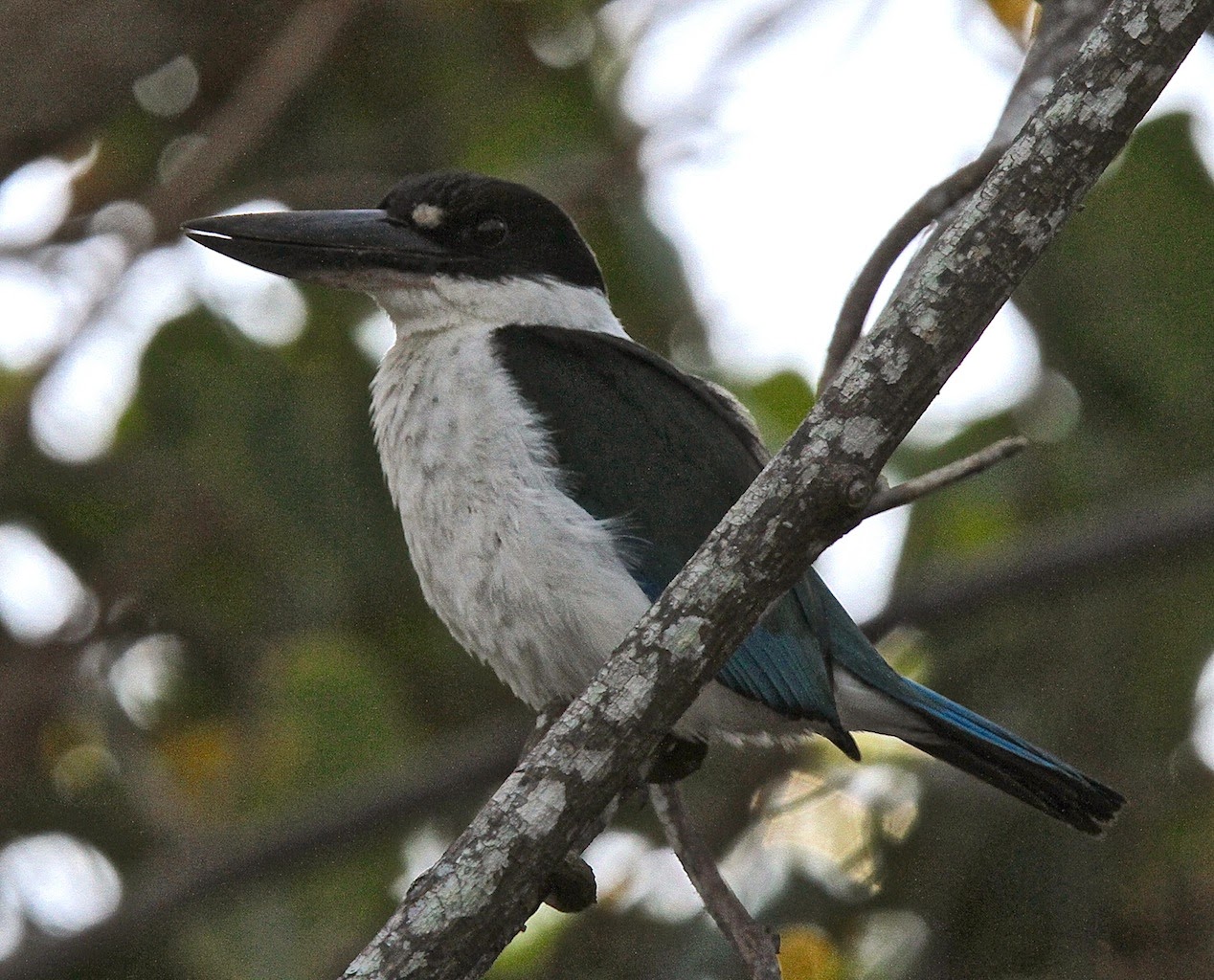
In the mangroves behind the dunes Forest Kingfisher was calling loudly. He was sitting on a branch close to a termite mound with three freshly dug holes. Although I hid and waited for some time he would not go near the nest while I was there.


In the rainforest the mango pine, left, Barringtonia actangula flowers are hanging secluded beneath the trees bright green new leaves.

The flowers on the white apple tree, syzgium forte are proudly displayed above the thick canopy of the tree.

Soon these trees will be full of fruits much loved by the cassowary.


While the feast of blue quandongs, Elaeocarpus eumundi is coming to an end, many of the leaves on the trees are turning bright red and gold. Left a female fig bird eyes off the last quandong fruit on this tree.


Green sea turtle Etty B is putting on weight, she is eating up to 30 pieces of squid or prawns in one sitting and her shell is healing strongly. Right, Nellie Epong feeds Etty B after Henry pumped clean water into her tank.


We were delighted to play host to a party of visitors from St Johns. They walked around the nursery then had refreshments and shared many stories of the old days with us.


If you go for a walk in rainforest this week look out for nutmeg fruits, Myristica insipida which are ripe and falling.

Cheers for this week,

Yvonne