Hello from the land of three shades of blue,

 Crisp almost cloudless days with low humidity, all this week, has kept the skies over the rainforest blue, setting a frame for the Bartle blue of the mountains which sit in the blue waters of the Johnstone River ringed by emerald green rainforest and white sandy beaches. It can't get much better than that.
Tonight another 'super moon' rose in a hazy sky over the Coral Sea. As the winds start to freshen tomorrow they may push this week's King Tides a little higher.
 |
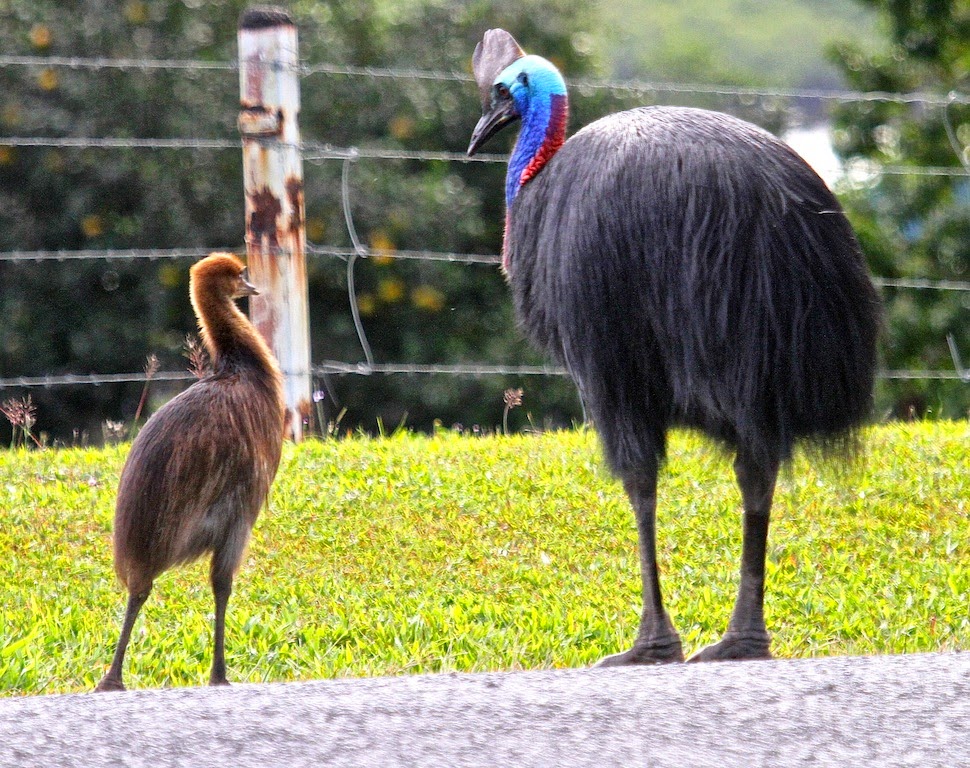
| When Ky saw Jessie he stopped in his tracks. |

Cassowary Jessie occasionally encounters Snout and Ky and this week for the first time I saw her chase Ky.

 |
| Cassowary Jessie almost on top of Ky |
 . ……I was worried Jessie would harm Ky when suddenly Snout rushed between them and Jessie turned her attention to him and chased Snout into the rainforest. It was all over in a minute. It was just luck that I was there with the camera at the time.
I was only able to take these photos safely as I have a long distance camera lens and I was standing some distance away protected by the trunk of a tree.
The next day Jessie looked as if butter wouldn't melt in her mouth and I think I saw her smiling.

 I have often seen what looked like stones in cassowary scats and when I saw Jessie eating something on the road I discovered it was in fact basalt gravel. Many birds swallow pebbles and sharp stones to help grind food in their gizzard. These rocks are known as gastroliths.

 Cassowary Ky is maturing and he observes everything his father does. When the birds move into the trees above, Ky looks to watch for falling seed. His feathers are darkening and the colour is showing through on his neck.
 As I drove home early this week I saw cassowary Queenie on the side of the road she was looking down a gully that ran beside the road. Unfortunately a three wire strand barbed wire fence runs across the bottom of the gully.
I watched as she disappeared down the almost vertical bank.

She reached the bottom, saw the fence and came straight back up the bank.
 When she reached the road she went back the way she came, into the mangrove swamplands on the Ocean side.
There are a lot of dangers for Cassowaries around rural and urban areas.


The northern brown bandicoots are on the move and I have seen quite a few scurrying around in the early morning. They leave a tell-tale sign in the lawn when they dig holes looking for tasty grubs.
The northern brown bandicoot is solitary but will come together with females for mating. The male will follow the female until she accepts him.
The northern brown bandicoot is solitary but will come together with females for mating. The male will follow the female until she accepts him.

 |
| Yellow sigatoka affecting native banana |

Aerial spray operators are busy over the banana plantations around the Cassowary Coast. After three months of wet weather there has been a serious outbreak of Yellow Sigatoka disease in Cavendish banana plantations. Farmers are controlling the fungal disease by aerial spraying fungicides every three to four weeks on each crop. Some of the chemical fungicides sprayed are Dithane, chlorothalonil, propiconazole and mancozeb.
Yellow Sigatoka disease was first identified in Western Australia in 1990. Since then it has spread to infect banana crops across the tropical north of Australia. The economic, environmental and human health impact from Yellow Sigatoka disease on bananas is high. The risk of other horticultural disease entering Australia is also high. All of us need to be alert and report people who illegally carry plant material when returning from overseas holidays.


Drongo and Friarbird are having a territorial dispute.
Drongo screams out a cheeky song and this annoys Friarbird who replies with what sounds like expletives.
Drongo always seems to have the last word and puffs his chest out and looks at Friarbird with disdain.


 |
| Juvenile beach stone curlew |
 |
| Beach stone curlew at sunrise |
 |
| Beach stone curlew at sunset. |

The brown cuckoo-doves are also still here and enjoying the sunshine.

Male yellow-bellied sunbirds are putting on a noisy display to attract their females. This bird puffed out his chest feathers and bobbed his head up and down in a little dance. Unfortunately I did not see him display his pectoral tufts.
The male yellow-bellied sunbird will erect pectoral tufts during display. They appear like two little fans from the side of the bird's neck. A wonderful sight if you are lucky to see it.


 Rufous fantail has been taking a dip in a pool late every afternoon. One wonders why he leaves it to the cold of the late afternoon to take a dip.
Now that the sugar-cane harvest is underway pheasant coucals can be seen on road verges. Many of these birds make their nest in the sugar-cane fields and are now homeless.
These birds will run out and cross the road at the spur of a moment.
 They are very well camouflaged for brown grass and when they enter these areas they are hard to see.

The masked lapwing plover is nesting on the rookery at Coquette Point. Plovers are notorious for the way they defend their nesting site.
These birds are common in urban areas and will make their nests in paddocks and parks. They will tolerate people except when nesting.
Ruth L commented this week that she thought the population of masked lapwing plovers at Coquette Point had increased as she has observed several groups of these birds around the top of the Moresby Range at Coquette Point.

I love their tenacity, it is not unusual to see a lapwing chase off a much larger bird and even a dog. They are certainly good alarm sentries, as they will sound alarm at every intruder.

My daughter Justine and her husband Thierry with my granddaughter are visiting at the moment. We are celebrating 'Christmas in July' and there is no better time of the year to have visitors in FNQ.
Justine lives in California and they have been experiencing severe drought for the last four years.
At this time of the year the citrus fruits in FNQ are loaded on every backyard tree. I had a bowl of limes and lemons in the kitchen and Justine picked up a lime and said at the moment in California limes were more expensive than alcohol. The price of limes has had a flow-on effect in the tourist trade where one of the favourite tourist drinks, margarita, which is based on lime juice, has almost doubled in price.


It has been a momentous week for the Aboriginal community of the Cassowary Coast. NAIDOC week this year honoured the Aboriginal men and women who served Australia in all conflicts.
During the morning tea celebrations for NAIDOC week at the Innisfail Shire Hall on Tuesday we launched 'Jigurru'. 'Jijurru' is a rainforest story developed with Mandubarra elder Nellie Epong, Anne Wilkinson, Liz Gallie and me. To look at the book go to:- www.yvonnecunninghambooks.com
Gathered together after the launch of the book, photo from left; Henry Epong, Nellie Epong, Yvonne Cunningham, Liz Gallie, James Mcgillivray and Mervin O'Donnell.
On Wednesday NAIDOC week was celebrated with dancing and speeches in Canecutter Court, followed by a march down the main street of Innisfail to ANZAC park.
NAIDOC week celebrations in Innisfail were organised by the wonderful Karen Yaroseray who not only organised the event but acted as master of ceremonies. Well done Karen you made the Aboriginal community of the Cassowary Coast proud.

Yesterday, 11 July 2014, marked the United Nations World Population Day. As of January 1, 2014, the world's population was estimated to be 7,137,661,030 and is increasing by 2.3 people every second.
Climate change threatens food security in many countries. This is particularly evident with the frequent extreme weather events that have been occurring on Earth over the last decade.
To stop global overconsumption, depletion of resources, unprecedented loss of species and to reduce dire human poverty the world population needs to be between one and three billion people. That is the population range to be truly sustainable, long term, on the planet. To learn more go to:- http://www.worldpopulationbalance.org/content/one-planet-onechild
Cheers for this week,
Yvonne




.jpg)
