Saturday, 5 October 2013

Hello from Coquette Point,

A fast moving front brought a weather change on Thursday morning and dawn broke to a splendid display of red mackeral sky.
A sudden change in the wind from NE to SE and by late afternoon the front spurned the first storm of the season, 21 mm of rain, hail and strong winds whipped through the Atherton Tablelands as the storm passed. By the time it reached the coast it had run out of puff and only 1mm of rain was recorded at Gordonvale and none in Innisfail.
However, a strong, cool breeze raced up the Johnstone River towards the low pressure system bringing a welcome relief to the heat.
The storm shaded the sun and the thunder rolled over the Innisfail Valley. The bush stone curlews started to tweet, it was a most unusual vocal call for these birds which are renown for their loud, wailing, nocturnal calls. One bush stone curlew ran from the rainforest quickly followed by a second bird. As the thunder rolled they moved together startled and uttering low tweets.

 Suddenly the birds took to the air and flew into the mangroves on the northern side of the river.
By the sound of their calls, over the last two night, they have returned with a few mates.


Clusters of scented, small, white flowers cover the mangrove Aegiceras corniculatum in spring. These flowers are full of nectar and attract both native and exotic bees, in fact the nectar from the flowers of this particular mangrove makes a substantial contribution to the production of honey in coastal areas in tropical Australia.

Sex in the mangroves.

A. corniculatum also plays host to a number of molluscs and the mangrove snail Melarapha scabra is mainly found of the leaves of this species of mangrove.  The snail below has just deposited a pile of dung and a mucus trail is being excreted behind it.  Gastropod sex is on in the mangroves! The mucus trail is laid by the sexually ready female snail and the male follows the mucus trail to locate the female. Note there is a hitchhiker insect on the shell.  


 The mangrove snail is a particular favourite of the cassowary and is the main reason you often see cassowaries in mangrove forests.

  Talking of cassowaries, I haven't seen any sign of the matriarch Jessie or her partner Snout this week. Hopefully, Snout is sitting on eggs and Jessie has gone off to look for another eligible male.


The shrill calls of the osprey parents are a constant background noise of the Johnstone River estuary this week as the parent birds teach the juveniles to fish.


The bright white tips on the youngesters feathers and dark head markings makes it easy to identify the juvenile osprey as other than the markings they are the same size as the parent bird.


Summer brings flies so it is always good to have a friendly jewel spider or two around; their favourite food is flies.

Once fly was caught in the web the jewel quickly wound in her catch. Over the next hour she sucked the juices from the fly until only the skeleton was left.


The meal finished she repaired her web and waited for the next victim. Sorry if you find this gruesome most of us have never faced up to the processes of our own meat-eating.


The week wouldn't be complete without finding another species of jumping spider. Unfortunately yet another Salticidae I was unable to identify from the online photo-bank of this spider.


The hot weather has brought to the surface another summer visitor, the shield or better known stink bug. I found this pretty little fella on a granadilla leaf. Not all shield bugs damage plants many of them are mite and aphid eaters.


Stick insects have also started to appear and this flightless male has an unusual body armour.


Juvenile metallic starling


The metallic starlings are busy feeding on the abundant fruit offered by the rainforest. Figs are their particular favourite and it is the starlings habit to pick the fruit and fly to a nearby tree to consume it. In this way they spread the seed and join the other rainforest farmers of the Wet Tropics like the cassowary and the flying fox.


 A brief rain shower fell early this morning and before it was finished termites on their nuptial flight filled the sky. Generally this is a signal that the wet season will start within the month.

I went to the Palmerston on Friday and I have never seen, felt or been stung by so many march flies. Not since the 70's have I seen them in such large numbers. Fortunately Coquette Point does not get a lot of march flies, however, we make up for it with sandflies and mosquitoes.

Enjoy the day,

Cheers,
Yvonne


Saturday, 28 September 2013

Hello from Coquette Point,

The weather on the Cassowary Coast is perfect - for the moment, with days of 29 and nights of 19. On the other hand, the IPCC climate report released on Friday paints a worrying picture for the future climate on Planet Earth. Australian meteorologists have stated that 2013 is already Australia's warmest year on record and summer hasn't started!

This year the north Australian Monsoon failed and this has resulted in searing drought across Northern Australia. Rainfall deficiencies have been recorded over most of Australia and combined with above average temperatures, bush fires are raging from the south to the north of the country; a desperate time for farmers and wildlife on the land.

Every morning this week cool land-breezes have pushed rolling fog down the Johnstone River and out into Glady's Inlet creating 'a grey mist on the sea's face' while an orange dawn was breaking. Greater egret, standing on the edge of the mangroves struggled to find a fish-meal through the mist.

So far this year I have only seen three Pied Imperial Pigeons 'sleeping over' in the melaleuca trees at Coquette Point.  Over the past ten years I have counted between 10 and 12 birds nesting in these trees; hopefully, more will turn up soon. However,  large flocks of these beautiful pigeons can be seen flying over the valley of Innisfail and the numbers appear to be about the same as last year.

The Brown Laurel, Cryptocarya triplinervis is in full fruit and the Pied Imperial Pigeons, moving through the tree with particular agility are taking full advantage of the feast on offer. The stain from the fruits colour the feathers of the feeding birds.


At long last the sunbird babies have fledged safely and flown to a nearby tree. This sunbird built her nest in a bougainvillea, the thorny rambler offering built-in protection.  When the babies fledged they flew to a nearby tree and mother sunbird devotedly attended to the fledglings searching for insects. I watched her examine the new leaves on the Johnstone River Almond, she appeared to understand that insects would be more likely to be found in the sweet clusters of new spring leaves.


Her search was finished when she spied a spider and quickly clutched it in her beak and fed it to her demanding infant.


The Osprey chicks have also fledged. The larger chick took to the air without any encouragement from the parents. The other chick was not so adventurous and would only venture onto a branch close to the tree. Eventually with much calling and 'how to fly byes' by the male the young osprey sprung into the air effortlessly.


Mother Osprey whistles encouragingly to her chick to take its first flight, while father Osprey flew around the nest showing the chick how easy it was to fly.

The chick took its first flight to a nearby branch while Mum whistled encouragement and Dad turned his back impatient, himself, to go fishing.
Now with confidence the chick launched into the sky quickly followed by the two adults and they flew into the setting sun towards the winding Johnstone River.

Today all four Osprey were flying over Coquette Point searching the river for fish.


The female Indian Koel is avoiding the company of the male. Often in the morning she calls with a shrieking, loud, impatience coo-eee from the trunk of a dead tree. He answers her from the seclusion of the fig tree and then they go their separate ways to feed in the rainforest.


Ciriono and his pelican mates appear to be enjoying each others company. They wander down to the river early in the morning then spend an hour frolicking in the water and preening their feathers.


Pelican bath-time.


Large numbers of Pacific Golden Plovers have arrived at Coquette Point, many of them are still showing breeding plumage.


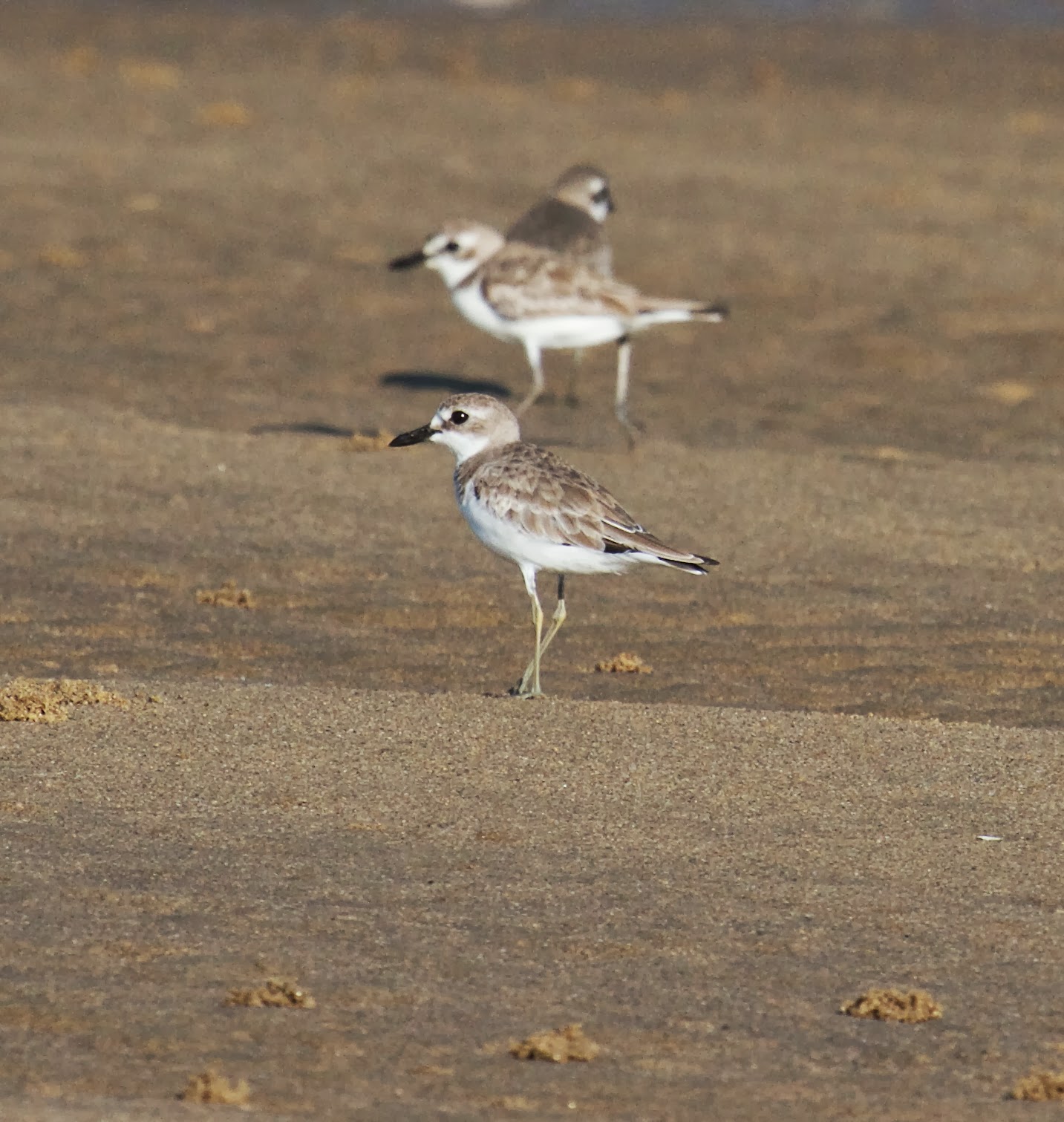
Greater sand-plovers have also arrived.


Tiny lesser sand-plovers scurry across the sand.


Pied oyster-catchers search the sand with whimbrel -


and they are  joined by more grey-tailed tattlers also showing breeding plumage.


Bar-tailed godwits fish alongside the plovers.


Red-necked stints are busy finding  breakfast.

What a privilege to walk along a beach and observe these migratory shorebirds feeding in peace.


Jumping spiders are renown as superb huntsmen. However, it goes to show that no matter how good you are if you drop your guard some-one or thing will take advantage.

Mud dauber wasp unlike her cousin potter wasp is an aggressive hunter and seeks out spiders to feed her larva.  When she captures a spider she impales it with her sting and injects paralysing saliva into the prey.


Clutched in the wasps mandibles the paralysed jumping spider  is flown off to the mud duber's burrow.

Some genera of these wasps 'even use the tool of a stone held in their mandibles to help construct the burrow'. (A Field Guide to Insects in Australia by Paul Zborowski and Ross Storey.)


Drama happens all around us if we take the time to look.


While we enjoy this long spell of dry weather the green-ants are uncommonly busy building large nests high in the trees and stocking them with food. Generally this is a sign of a big wet to come! I think we have seen, often enough, that drought is always followed by flood.

Cheers for this week and be prepared.

Yvonne