The summer heat is blistering and with the humidity in the 90's it's draining, but that's what we expect at this time of the year. Relief does come briefly, when a storm brings cooling wind and rain. However, if you are right under the storm it is not so good, one banana farmer on the Palmerston last week lost 100% of his crop and stood down 30 workers until March. Another lost 90% of his crop and a work crew of seven men have lost their jobs. A pawpaw farmer lost 75% of his crop while widespread damaging hail was recorded from a storm that arched over the Innisfail hinterland last Saturday evening.
Storms have continued every afternoon this week bringing refreshing rain to the dry soils. In central Queensland drought has turned to minor flooding but no one is complaining.

Whether it's the nitrogen in the air from the storms or perhaps young cassowary Ky is starting to feel his oats, but this week he was celebrating his first year with crazy dances and jousting with trees. The exuberant behaviour seems to happen spontaneously in the late afternoon. Sort of cassowary schoolie's week for Ky.


 Ky stopped mucking about and shortly afterwards quietly
followed his dad into the rainforest.

I have observed two encounters between Jessie, Snout and Ky this week. The first one was close to the house where I saw Jessie sitting in the sun, I thought it was strange that she would do that on such a hot day. Then suddenly Snout appeared with Ky further back in the rainforest, Snout was watching Jessie intently.
The cassowaries stayed in the same place for some time. Occasionally Ky uttered a nervous whistle.
It was at least 20 minutes before Jessie gave up and decided to approach her unwilling lover, but Snout once again had cold feet and disappeared into the rainforest with Ky running beside him .


The next day I found them all together again and this time Snout gave every impression he was trying to attract Jessie by giving her the 'come on'. However, on this occasion it was Jessie who walked away uninterested.


 |
Cassowary Hero has been bringing his new chick into the Panama berry tree beside the road at the top of the Moresby Range. Henry and Nellie Epong have recorded them at this tree almost every day this week.

Going to town on Wednesday I found cassowary Hero and his new chick resting in the shade under the tree.

 Soon they started to feed and I watched Hero stretch up and pluck a berry and drop it on the ground in front of the chick. The chick picked up the berry, tossed it in the air, caught it, and swallowed it all in one throw.
 Alison Whatling has advised that she has seen the Flying Fish Point cassowary dad Kevin again and he actually has three chicks not two as previously reported. They are very excited and are looking forward to the Christmas school holidays to get some good photos. Alison said they have lots of fruits falling in their rainforest patch so the chicks should be well fed.
 The new cassowary subadult which appeared at the top of the Moresby Range a few weeks ago is back. I spoke to Mandubarra elder Nellie Epong, who has been watching this young cassowary and Nellie has named it Henry, after her husband Henry Epong of course, a tall proud Mandubarra man.
I believe Henry is Hagar's chick from the 2012/13 season. Hagar presently has another chick Rainbow which is nine months old. Photo above left Henry, right Hagar with Henry August 2013. Photo by Taggs.

She then started to sing to him but it didn't hit the right note and he looked disinterested.


When she changed the tune she caught his interest.
All the excited singing also caught the interest of another female which joined the two and tried to compete for the male's attention.


The characteristic coo-cooing call of the peaceful dove is mesmerising. During courtship the male peaceful dove commences a series of head bowing and tail raising. The female often acts coy
to this behaviour which seems to encourage the male to more extravagant display.
The peaceful dove often raises more than one brood per season and it is one bird that appears to have benefited from humans clearing forestlands as its preferred habitat is open woodlands.

In my early morning walks on the beach I managed to get a photo of the pied oyster catcher family in one frame. The two chicks are on the left and the bird about to go on guard duties is walking off to the right.
The parent pied oyster catcher which stayed with the chicks appeared to be teaching them how to find a meal. In the soft glow of early morning they ignored me as I stood behind a mangrove tree watching the parent bird show the chicks where
and how to feed.


 A young silver gull flew across the sand flats and as it turned I noticed it had an injury across its wing and on its tail. The damage was on the surface and did not appear to be preventing the bird from flying. It may have escaped from a crocodile but it is more likely to have been an encounter with a dog, one lucky gull.
As I continued my walk I noticed someone had been on the beach earlier than me and there were several sets of dog prints, at times alongside a man's print but at other times leading off in long strides out onto the sand flats.
I saw very few terns or waders inshore, however I did see some activity on an exposed sandbar far out in Gladys Inlet but could not investigate due to the tide.
On Wednesday participants in the Cassowary Coast Alliance met with staff of the Cassowary Coast Regional Council, CCRC, about dogs, Quad bikes and other illegal activities damaging the beaches of the Shire.

 The Quad bike on the left was driven along the dunes where the green sea turtles have laid their eggs. The Quad bike driver, not happy with driving on the dunes, would suddenly turn down onto the beach do a few burnouts then back up onto the dunes. He was hooning on his Quad bike, smashing turtle nests, undermining the dunes while destroying the dune vegetation.
With this sort of activity on our turtle and shorebird nesting beaches there is no hope for these species to breed or survive in this habitat.
CCRC officers have requested that people report bad behaviour on our beaches to the Council and if possible, in safety, take a photo and record vehicle licence plate numbers to the Council's Nuisance Issues Desk. Go to:- www.cassowarycoast.qld.gov.au and click on Report an Issue in the left margin, or phone the desk 074030222, or email enquiries@cassowarycoast.qld.gov.au The Council Environment Officer, Damon Sydes said he cannot act unless he has the complaints. People are not reporting incidents of Quad bikes or dogs on the beaches, but if they do he will act. So it is up to you, don't whinge about an environmentally damaging issue, report it.
One issue that was reported to Council by Duncan Patterson concerning dogs, occurred at Flying Fish Point. Apparently a lady drives from Innisfail almost every morning with a number of very large dogs, lets the dogs loose in the Environmental Park on the foreshore at Flying Fish Point and the dogs run and chase the wildlife until the lady takes them back. The other week the dogs dug up a number of rainbow bee-eater nests that Duncan and his wife Mary had been watching. Duncan spoke to the lady about the issue and reported it to Council but the dogs still run wild in the Environmental Park almost every morning. I spoke to Duncan today to get an update on the issue, nothing has changed.
The rainbow bee-eater is in the bee-eater family Meropidae. It is the only species of Meropidae found in Australia. The rainbow bee-eater is listed as Least Concern under the EPBC act but small populations of these birds, like the one at Flying Fish Point, can disappear if their nests are constantly destroyed.

Last week I was at Kurrimine Beach for the Mandubarra Community Day and turtle release, whilst I was parking my car I discovered a rainbow bee-eater nest on the road verge. You can see the nest in the foreground where fresh grey sand is piled up.
Fascinated I sat in the car watching the bee-eater come and go feeding its babies on a wide range of insects.


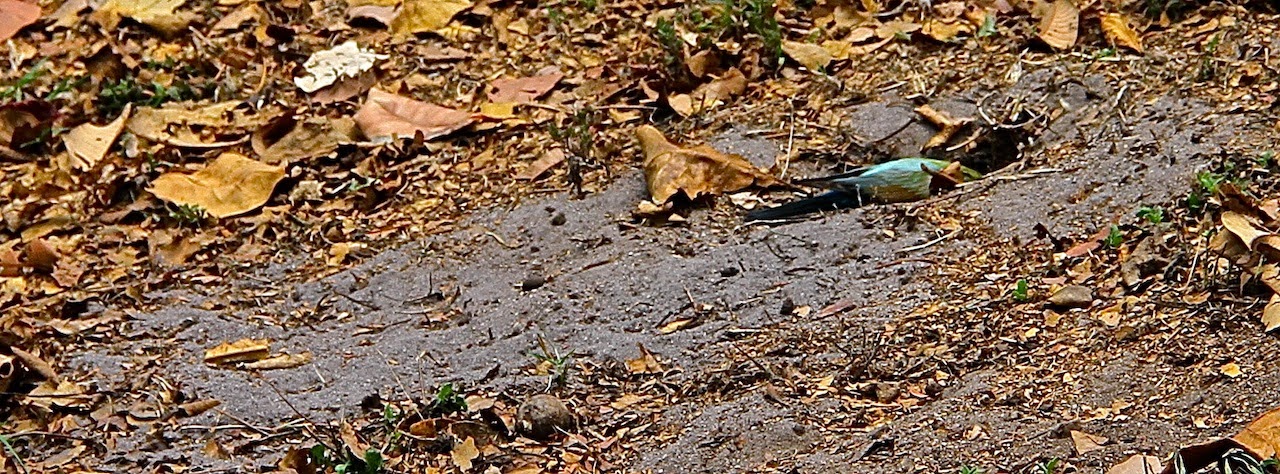
The rainbow bee-eater is one of Australia's most spectacular birds, it builds nest tunnels a meter long which are used for roosting in the breeding season. The male rainbow bee-eater has two long tail feathers while the female's are short. The colouring of both sexes is similar.


I thought what hope do these nestlings have to successfully fledge in such a site, close to a drain and in a Council mowed road verge. The Kurramine Beach Cafe was diagonally across the road and I went to speak to the manager and ask for his help to protect the bee-eater's nest. The Manager's name is Maurice and with amazing serendipity I discovered Maurice is a keen bird photographer and had been watching the bee-eaters on the sign post but was not aware they were ground nesters. Maurice immediately volunteered to keep a vigil over the bird's nest and said he will speak to Council workers when they come to do maintenance in the area. The bee-eaters offer a great tourist attraction for the cafe.
Later I went to the Kurramine Beach Cafe, with Richard and Karen for a cup of coffee and received
the best service and best cuppa in spotless surroundings. I recommend the Kurramine Beach Cafe. If you visit ask Maurice to show you the bee-eater's nest.

 You always know Christmas is near when the beautiful flower- baubles of the Leichhardt Tree, Nauclea orientalis open to the sun.
Also showing a decorative touch this week is the Glory Vine Faradaya splendid with its large white egg-shaped fruit hanging in clusters from the rampant foliage of the vine. This is a favourite food of the adult cassowary but it is too large for the chicks to eat.
Pommy the mysterious caterpillar has metamorphosed into a fibrous cocoon. The caterpillar crawled out onto the net and down to the lower folds of the net near the soil in the pot. It formed a cocoon between the folds and drew the net together completely covering the cocoon. Neither Jack at the Insect Farm nor entomologists, Richard P or Bill F can identify the cocoon, so it is a wait to see what hatches.


The cocoon is 6 cm long and 2 cm wide. The net firmly encircles the cocoon with the spines protruding on the outer surface. Whatever species of moth it is, it must be large and perhaps nocturnal like its caterpillar.
Jack has instructed me to spray the cocoon with water every couple of days.
Cheers for this week,
Yvonne


