Saturday, 11 October 2014

Hello from dry and dusty Coquette Point,


Two months without rain and the backyard lawns of the Wet Tropics are brown and crinkly. The epiphytes in the rainforest canopy, like the basket fern, Drynaria rigidly, have dried back to their 'nest' leaves and they wait for the first rains of the storm season, 'Jigurru', then the new green fronds will appear in a burst of life.

The cassowaries are looking for water and Snout and Ky have been drinking from the nursery ponds every day this week.
Cassowary Ky has a bath


When they arrive they scoop the clean water up in their beaks and throwing their heads back drink deeply. When their thirst is quenched they spend up to fifteen minutes washing and grooming their feathers. No spot is left untended as the cassowaries go into contortions to reach every feather on their bodies.
Cassowary Ky cries

On Wednesday I heard Ky uttering distressed calls from the rainforest. I went to investigate and found him sitting alone on the rainforest floor calling for his Dad.


I detoured around Ky and walked down the track a little way then I saw Snout in the distance watching. I thought you clever Dad, you are giving Ky a taste of independence while at the same time keeping an eye on him, but Ky didn't want to be alone.

Snout must have made a noise as suddenly Ky jumped to his feet and ran to Snout and they walked off together into the rainforest without a sound.


The next day Thursday they were walking together and Ky seemed to be keeping very close to Snout.


Today Jessie turned up and she hung about all day watching. When Snout and Ky came in to drink they didn't stay to bathe but as soon as they quenched their thirst they walked off quickly into the mangroves. It appears Jessie is again inviting Snout to commence courtship.
Cassowary Jessie watches


There is a great deal of activity from the metallic starling camp as they have started to rebuild their nests. Great flocks of metallic starlings are flying in missions to collect building materials. They return in ones and twos to their nests with pieces of dried plant material streaming from their beaks.


It is fascinating to watch them harvest the pieces of plant material.


The metallic starlings pull and shake the dried vines using their whole body weight to part the twine.


This week I had the first sighting, for the 2014 season, of the green spotted triangle butterfly. A female was laying eggs on an exotic sour-sop fruit tree. The native host is the vine Melodorum uhrii, which is in the same family of plants as the soursop, Annonaceae. It is astonishing that the green spotted triangle butterfly could recognise through smell the exotic sour sop tree as a suitable host plant for her caterpillars.


There has been a big hatching of lurcher butterflies around the mangroves. When they fly out of the shadows and into a shaft of light their true beauty can be admired.

Lots and lots of Cairns bird wings around, both male and female.


I was sitting on my favourite seat near the sediment pond when I saw a small bird hunting in the cottonwoods trees, hibiscus tiliaceus, it looked like a female leaden flycatcher, but I had not seen nor heard any for over a month as I believed they have all left for their southern breeding migration. I noticed its call was not harsh like a leaden flycatcher and as I watched the little bird hunting I felt it might be a female satin flycatcher. Satin flycatchers migrate from as far away as Papua New Guinea to southern Australia for breeding, normally they are all gone by October. The female satin flycatcher has a darker cap than the Leaden however, as I was looking up in the shade of the cottonwoods I was unable to get a top head shot. I looked for her again over the next few days but she was gone. When you examine the migration journeys of these little birds, you are left with wonderment of the natural systems and the forces that drive them.

The shining flycatcher is a resident of north Queensland and its harsh croaking call and replying whistling call are commonly heard in coastal riparian areas and mangroves.

This week I watched a new male shining flycatcher try to win the heart of the resident female. He flew into the tree and looking very cranky tried to out sing the other male while  jumping from limb to limb with pirouettes and tail twitching.

The female shining flycatcher watched the males intently and also engaged in tail twitching and shivering as she sat on a nearby tree limb whistling loudly showing her red mouth gape and raising her semi-crest. She was flirting with the males and enjoying their attention.

Eventually one of the males retreated and the winner dropped to the mangrove floor to feed followed by the female; another magic moment in the mangroves of Coquette Point.


Every day this week there has been  confrontation between the pheasant coucals and a female common koel. The pheasant coucal's call resound over the Johnstone River estuary with a deep oop-opp-opp, increasing in pitch and speed. Although this bird is a cuckoo it does not parasitise the nest of other birds, whereas the common koel, which is also a cuckoo, does. It appears at the moment the female common koel has her eyes on pheasant coucal's nest. As both the male and female pheasant coucal share the nest duties their nest is not left unattended and common koel is having a battle to deposit her eggs in their nest. By the sound of the ongoing calls and chasing she is not having much luck.

I watched the male pheasant coucal chase the female koel into the canopy of a large milky pine, Alstonia scholars where she hid in its thick canopy.  Phesant coucal triumphantly looked at her from the branch of a nearby dead tree.


The candlenut tree Aleurites rockinghamensis is in full fruit and a solitary pied imperial pigeon is visiting it twice a day to feast on the ripening nuts.

Of a morning she calls mournfully for a mate but this year she is the only PIP staying at the Point. Every year since cyclone Larry I have noticed the numbers of PIPs in the Johnstone declining. Perhaps they are staying elsewhere, it will be interesting to see the trend in their population when the count is done early next year.
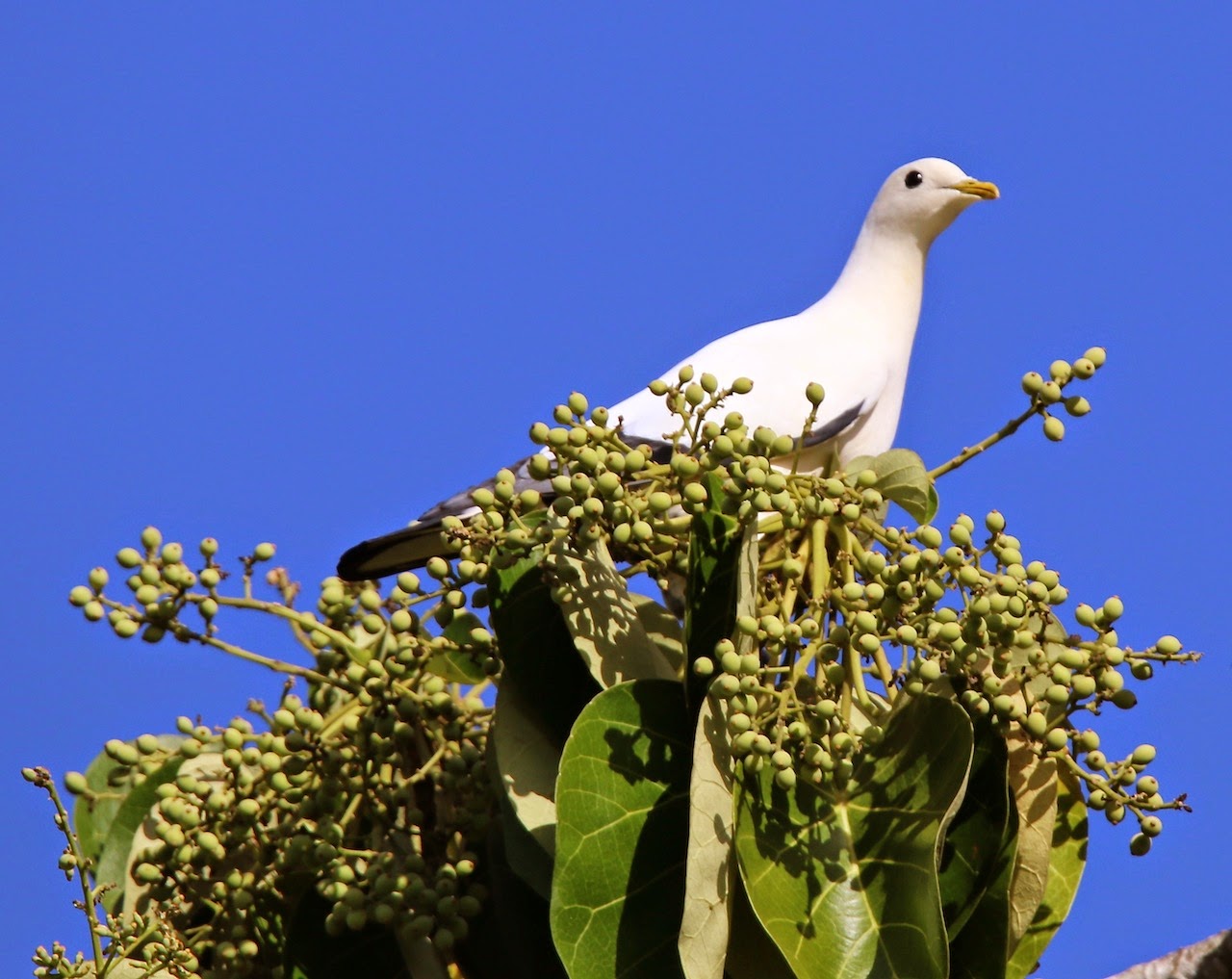


The sulphur crested cockatoos are also enjoying the candlenut tree's fruits, but they generally visit the tree in the late morning.

With the long dry spell the agile wallabies have been drawn to the orchard where there is some green picking around the fruit trees. I have not seen any joeys in their pouches. However the males look primed to mate.


The northern brown bandicoot has been staying up late and I found this one hurrying for home at 8.30am in the morning, well past its bedtime. Perhaps the dry weather is also affecting the availability of bandicoot's tucker.


Lots of flowering in the rainforest with the October glory vine, Faradaya splendida, looking splendid indeed.

The yellow-green tentacles of the butterfly plant, Macaranga tanarius, are attracting lots of insects while seed from last year's flowers are still on the tree much to the delight of the metallic starlings.


Layers of tiny white flowers cover the branches of the pink ash tree, Alphitonia petriei, as the tree's large dull leaves droop from thirst and a heavy coating of dust.


The long dry weather favours bottle brush trees, Callistemon sp. Their flowers are full of nectar and I watched rainbow lorikeets and yellow spotted honey eater having a feast. The joy was too much for yellow spotted honey eater and he burst into a song of thanks for the gift of the sweet nectar.


Find joy in the day wherever you are,

Yvonne.

Saturday, 4 October 2014

Hello from dry and smoky Coquette Point,

Although the sky is full of smoke no fires are burning at Coquette Point. However, landholders in the district are burning. Starting a fire this late in the season will inevitably be difficult to stop and one wonders at the wisdom of granting fire permits in such hot dry weather.

September is the start of the cassowary and pied imperial breeding season and it is heartbreaking to know these birds will be 'burnt out' of large areas of the Cassowary Coast, again.

The smoky atmosphere turned the sky pink in the first rays of pre-dawn. It is at this time that white-breasted sea eagle patrols the Johnstone River and the pied imperial pigeons journey from the swamps and offshore islands to the coastal rainforest to feed.

The mornings are delightfully cool at sunrise and it is always the very best time for an early morning walk on the beach. Unfortunately the light for photography is not good and on Tuesday morning as I walked alongside the river I saw a large dark shape in the water moving very slowly. Occasionally there was a bubble of disturbed fingerlings . At first I thought it was a turtle and at no time did I feel or think it was menacing. I took several photos but could not identify the shape. I asked Russell Constable to look at the photos and he ran an analysis on his computer and his result is that it is most likely a Queensland grouper.  I have not seen the fish since in spite of searching every morning in the same area.

Giant Queensland groupers were once common in the Johnstone River and one particular fish became famous with locals and tourists. The Wallace Fish Shop and the nearby Fish Board, for years, fed the gropers of the Johnstone, which were very tame, and one grouper was estimated to be over 100 years old. People would line up to see and enjoy the spectacle of feeding these gentle giants. Then one day some twisted person placed set lines in the river and caught and killed the groupers, their bloated heads were later found floating in Nind's Creek.

Ulysses of Beaver Cay was another tame giant grouper which was made famous by Perry Harvey. People came from all around the world to swim with Perry and Ulysses.

Brenda Harvey told me, "Perry never tired of explaining to all of his passengers, on his tourist boat the MV 'Friendship', the gift of the reef and his efforts to save it." Brenda said, "Perry did more to foster awareness of the reef and its problems than any newspaper article or television programme could ever do."

 Then one day Ulysses the grouper was found dead with a bullet through him. It was from that time when tourism started to decline in the Cassowary Coast Region; perhaps it was groper karma.  Time will show if our fortunes are linked to this new grouper's arrival and survival.

Today Russell Constable saw what appeared to be a large groper hunting in the shallows on the bank opposite the Innisfail wharf area. Russell believed the groper was hunting mud crabs in the shallows.


As the sun rose in the sky two of the six pelicans which have made the Johnstone River home took to the sky and flew up the river.

Far out on a sand bar three agile wallabies were standing looking across to the other side of the river. Then perhaps thinking it was not a good idea to swim the river, they hopped back into the mangroves.


As the sun's rays coloured the dark green rainforest of the Moresby Range National Park I watched eleven Pied Imperial pigeons arise from the Coquette Point wetlands and move amongst the rainforest trees to feed.

On the beach the sun's rays glowed on a bar-tailed godwit as it fed in the surf. Two more were feeding closer in on the shore line. This is the first returns for these birds to Coquette Point for 2014.


Sharp-tailed sandpipers

Further out on the sandbar I saw three sharp-tailed sandpipers feeding in the sand wave ripples. This was also the first sighting of the return of these birds for the season. Altogether there were about ten of these birds feeding on the sand flats.

Around ten Pacific golden plovers were feeding further out. Their numbers were down on last week's count.
Pacific golden plover 


Grey tailed tattlers, around six, were feeding solitarily over a wide area of the beach, there could have been more. There was no indication of any aggression as seen last week, but the birds were well apart. Still no sign of the flagged grey-tailed tattler I saw a month ago so he has obviously moved on.

I did not find any soldier crabs emerging in the morning low tide. Unfortunately tide and time did not offer me an opportunity to explore the late afternoon tides this week.

Grey tailed tattler


Out on the hazy horizon I could see a line of bulk carriers, I counted five. There appears to be an endless line of these ships constantly moving along the coastline.

Whimbrel searched for breakfast on the sandbar unaware of the ships passing.
Common sand-piper
Greater sand-plover


Hundreds of small waders were busy feeding on the sand and mud-flats at Coquette Point.


                                                            The red-capped plover is a small bird of 14 cm which inhabits coastal estuaries and wetlands. It feeds on insects, molluscs, crustaceans and worms found on beaches and mudflats. The red-capped plover is present all year and nests generally in spring. The nest is a small depression and contains a clutch of two yellowish-brown eggs. The incubation period is 30 days and incubation is mainly done by females. Prior to mating males can become aggressive and will engage in lengthy displays and fights for the dominance of females.


It was walking out on the sand flats when I noticed a lot of fluttering and heard high pitched tweets coming from the dunes above the high water mark on the beach.

As I drew closer I found two red-capped plovers engaged in an aggressive fight. They were so absorbed with each other they ignored me as I drew closer to photograph them.


One of the red-capped plovers ran down to the beach where I was standing and he fell down onto the sand. I thought he was injured in the fight and as I walked closer he started to walk on his wings towards me. Then with renewed energy he flew back to his opponent and continued the fight.

I left them to it and when I returned a half hour later I saw one of the males with what looked like a female. They walked up behind the sand dune where I left them in peace and with a bit of luck they will be able to nest safely.


As I walked back along the beach twelve black kites suddenly appeared and circled above me. Several were hovering over the beach and some of the kites landed on the beach.

I had never seen black kites on the beach before and wondered what they were doing.

It didn't take long to find out. While I had been around on the front beach it appeared someone had emptied a net and left eleven catfish on the beach.

How amazing is the eyesight of the black kites and their sense of smell, to be able to hone in so quickly, on a few dead fish. As I watched the bird's circling I saw children across at the Coconuts playing on the beach with a dog in the water. If the kites could find the dead fish so quickly so could a crocodile. No doubt the idiot who left the fish on the beach would be the first to call 'rogue crocodile' if one was sighted. Salt water crocodiles are scavengers and will be attracted to feed where there is discarded fish guts and bait. Late October is the start of the nesting season and crocodiles can be aggressive at this time. It is our bad behaviour that brings us into conflict with these creatures.


I buried the fish and washed the smell from my hands.  I soon forgot about the smell of the fish as I returned on the walking track through the mangroves the forest was alive with the buzzing of bees and insects as they feasted on the sweet perfumed blossoms of the little river mangrove Aegiceras corniculatum. The flowers of this mangrove play a significant part in the production of honey.  Aboriginal people used the bark of this mangrove to produce a fish poison.

            Around the breather roots of the little river mangrove the spent flowers were falling covering the mangrove swamp with a white flower-confetti. When the tide came in it collected the flowers and as it ebbed it deposited the flowers in a line along the beach.


In the foliage of the mangroves varied triller was singing with ever increasing excitement as he feasted on the insects attracted to the mangrove flowers.

In the casuarinas close by a flock of yellow-eyed cuckoo shrikes were gobbling up the insects and singing a song of thanks to the new day and the feast of insects.


It was all too much for cranky forest kingfisher as he emerged from building his termite nest, his normally white feathers dirty from his excavation work. He soon forgot his bad temper as he shook himself off and looked around at the beautiful day and saw a meal close by.


Cousin kookaburra thought it was time to break into song and the mangrove forest resounded with the laughter of a dozen kookaburras.

Mangrove forests are both beautiful and mysterious and they are home to a wide range of special creatures.


One special creature sailed in through the mangroves this week, my good friend Bernadette. Bern sailed her dingy, 'Pookie' from Mourilyan Harbour on a light breeze to arrive in the Johnstone on a making tide with a good dose of sunburn. Bern has her dingy all set up for a quick getaway when she can.


Several cases of Ciguatera fish poisoning, CFP, have occurred in Innisfail recently. As a remote area nurse Bern is all to familiar with ciguatera fish poisoning and I myself have had three run-ins with the toxin and know never to eat large fish, particularly large mackerel as they are more often affected with the toxin at this time of the year. I am also aware that the toxin remains in my system and the next time I eat affected fish there might be a very poor outcome.

A friend rang me this week he had been out to the reef and brought home a good catch which he kindly gave to other members of his family. Unfortunately the fish, mackerel, were full of ciguatera and the family members became very ill. Ciguatera poisoning can be life threatening particularly if you have some underlining illness, like a heart condition or diabetes.

Although the dinoflagellate which produce the ciguatera toxin is a naturally occurring marine organism and it has been observed by the peoples of the Pacific for hundreds of years, it is thought that the organism is now more prevalent, certainly the cases of CFP reported have dramatically increased.

The only drug proven to be effective in the treatment of ciguatera poisoning is the diuretic drug mannitol.

The toxin accumulates in the fatty tissues of anything consuming affected fish including fish eating fish and people eating fish.  Ciguatera toxin cannot be tasted or smelt however the symptoms become evident within 24 hours after eating an affected fish.

Tingling and numbness in fingers, toes, around lips, tongue, mouth and throat.
Burning sensation or skin pain on contact with cold water.
Joint and muscle pains with muscular weakness.
Nausea, vomiting, diarrhoea and or abdominal cramps.
Headache, fatigue and fainting.
Extreme itchiness, often worsened by drinking alcohol.
Difficulty breathing in severe cases.
Heightened anxiety.

Catfish like the ones discarded on the beach at Coquette Point are good eating and are not affected by ciguatera toxin.

Enjoy your next fish meal,

cheers,
Yvonne