Saturday, 18 May 2013

Hello from Coquette Point,


The skies over Coquette Point are ringing with the shrill whistle of courting hawks.

The Osprey have completed the refurbishing of their penthouse suite which is neatly nestled in the fork of a dead tree. The nest site has  unencumbered views over the Johnstone River Valley to the West and an ocean view over the Coral Sea to the east giving the occupants easy access to both fresh water or salt water fish as they so desire.

Osprey live exclusively on a fish diet. Their hooked talons are very sharp and the toes have spiny projections. They dive feet first into the water, snatch the fish and carry their slimy, wriggling meal either back to their nest or to a nearby tree.

A few months ago I watched one osprey standing in the ocean  on a sandbar which was completely covered by the incoming tide, the water would have been a good 30cm deep and small waves were breaking around the osprey however this did not deter this avid fisher.

The wing-span of these amazing birds stretches 1.75 metres and when the wings are folded they reach the tip of the tail.

Most Hawks and Eagles can easily be recognised in flight by the shape of their tail feathers, which differ in shape in most species of hawk and eagle.

The female osprey is larger than the male and the dusky band or necklace on the fore neck of the female is strongly marked easily identifying her.

Osprey nest from May to September and build large platforms with a mixture of sticks held together and lined with seaweed. Last year, shortly after the eggs were laid, the nest of the Coquette Point pair was destroyed by a large goanna. Osprey usually lay three eggs which are pale buff, blotched with reddish-purple markings.
 
White breasted sea eagle is also very active at the moment. She has her nest at the top of a large paperbark tree in the Coquette Point wetlands. A pair of black kites are continually harassing her and perhaps she has an eye on their chicks. White breasted sea eagles will feed on a wide range of animals as well as carrion. Whereas the black kite lives almost exclusively on large insects but will eat carrion and hunt mice. Black Kites are commonly seen cleaning up insects and rats in cane field during and after harvest. Unfortunately, as with all raptors and owls they are often inadvertently killed when rat baits have been laid and the birds eat the poison meal.    
Note the distinctive difference in the shape of the tail feathers of these birds.   On the left two black kites harasses a white-breasted sea eagle.                                              


 Crested hawk is enjoying the sunny weather and much to my distress has been living on a diet almost exclusively of frogs. The wet weather over the last month has been ideal for frog breeding.

I noticed five crested hawks actively hunting in the Coquette Point wetlands this week. This area appears to be very productive and favoured by the hawks as these birds have remained in the area for the last twelve months. In the past the crested hawks left Coquette Point in summer and returned in Winter. Crested hawks breed in spring.


 Cassowary 'Brown Cone's' lone chick has grown quickly and Rakesh Krishnan kindly sent me this photo he took of Brown Cone and his chick on Friday. The chick appears to be staying close to dad and lets hope he learns some road sense as the area where they hang about is the long bend in the road near Ninds Creek.


The courting cassowaries Snout and Jessie have gone into hiding and I have not seen them all week. Hopefully in sixty days Dad will turn up with chicks.

                               I saw young cassowary Rosie this week and her foot has completely healed. She is walking normally and there is no sign of swelling in the pad. She regularly crosses the road at the top of the range walking from the melaleuca swamp down into the mangroves on the river bank.

The spangled drongos are constantly calling and appear to be happy to dominate the sky with song and acrobatic displays. When the shining starlings are here the drongos seem less active but now while the shining starlings have moved north for the winter the drongos have little competition.

I was watching a pair of spangled drongos perched tensely and on the look out for a meal. Their long tails were pressed hard against the branch where they were perched when suddenly they catapulted themselves into the air and one of the birds caught what looks like a giant mantid. Deftly he killed the struggling insect and before his mate could challenge him for a share of the meal he swallowed it down in three quick gulps.


The Meleleuca leucadendra, paperbark trees are in flower again and large flocks of rainbow lorikeets are noisily feeding on the rich nectar oozing from the flowers. The lorikeets fly in waves coming and going from tree to tree, much to the delight of visitors to the nursery this week.  When the sun reflects on their feathers the lorikeets gleam and shine reflecting all the colours of the rainbow on their wonderful feathers.


these North Queensland Day Moth glow in metallic green, blue and mauve.
 
 
I had some happy, willing helpers in the nursery this week and with Louise help they learnt to weed seedlings. Gary and Ethan enjoy gardening but they were absolutely delighted with the antics of the rainbow lorikeets and butterflies.


A new sign has appeared at the end of the Coquette Point road, 'No vehicles permitted on beach'. It would be nice if the pictograph also showed quad bikes and trail bikes which are the vehicles using and damaging the beach and the dunes.


Before I go a very big happy birthday to my dear friend Liz Gallie at Mission Beach. If you have time click onto Liz's blog http://missionbeachcassowaries.com. for some wonderful stories and photos of cassowaries and also the latest on Mission Beach. Enjoy the day Liz and thank you for the enormous contribution you give to all of us by speaking out courageously on behalf of all creatures and the environment of this area.
 
Cheers, Yvonne                                                                                                                

Saturday, 11 May 2013

Hello from Coquette Point,
This week strong wind and heavy rain has turned the Johnstone River into a fast flowing torrent, once again carrying the precious top soil of farmlands out into the Coral Sea Lagoon. When this happens the sediments in the runoff water settle on the coral and the nutrients contained in the sediments enhances the growth of algal species which smother the coral. In addition the 'dirty' runoff water reduces light in the water column which is necessary for the corals to photosynthesis.

A healthy riparian barrier between farmland and waterways, combined with good farm management including sediments ponds, drainage and green mulching will reduce sediment runoff dramatically. Farmers continue to lose their most important asset, their topsoil, the loss of top soil is killing farms while at the same time it is killing the reef. A healthy Great Barrier Reef will support a multimillion dollar tourism industry and a multi million dollar fishing industry.
So why is the Queensland Government getting  support to clear riparian vegetation? The King truly has no clothes and soon we will have no GREAT Barrier Reef.


 It is not all bad news for the health of the Johnstone River estuary. Some 20 years ago mud skippers had all but disappeared from the estuary, the reason for that is a long story, however, over the last few years I have noticed the mud skippers slowly returning. This week I saw hundreds of mudskippers around the mangroves and on the Coquette Point beach. They appeared to be playing in the surf and having a great time.


Mud skipper surfing
How cute am I?


The fruit of the bandicoot berry Leea indica is ripe and the cassowaries where quick to find it. The bandicoot berry is a fast growing sprawling rainforest shrub and it fruits on and off for most of the year. It is favoured by the cassowaries and was an important medicinal plant for Aboriginal people.

Jessie and snout ate all the berries on the ground.


Then Jessie stretched and stretched until she ate all the ripe berries high on the bush.
I was quite concerned when I saw Snout shaking himself frantically.I walked up closer and discovered he had a piece of dried leaf stuck in his eye. He shook and shook then scratched his eye.

Cairns birdwing butterflies are in a frenzy of egg laying. If an aristolochia vine is in the vicinity they lay eggs on it and on any plant close by. Here a female birdwing is laying eggs on a philodendron leaf .                                                                                                 The red lace-sing butterfly is one of the most striking butterflies of the rainforest. This butterfly took shelter in my orchid shed this week  where incredibly she started laying eggs on phalaenopsis orchids. The host plant for this butterfly is the red lace-wing vine, Adenia heterophylla, the vine is related to passionfruit and it develops bright red fruits a similar shade to the red colour in the wing of the butterfly and the fruits are full of small seeds, they germinate easily.  It will be interesting to see if the eggs hatch and if they do, what will the caterpillars eat?                                                                       
 

The white-banded plane butterfly is another rainforest butterfly species. When you watch this butterfly it seems to approach flowers very delicately and unlike most butterflies will hesitate to close its wings. It has particularly large and beautiful eyes and will slowly turn to look at you before it flies off. The scent organ on the antennae is large and of a contrasting pale colour and seems to give this beautiful creature additional ability and confidence in its surroundings.


                                                                             Pale green triangle butterflies have not faired well from the heavy rain and strong winds of the last two weeks, the few that are left around have damaged wings. Adverse weather creates major difficulties for butterflies and moths. The pollen and nectar they depend on is often washed from the flowers and strong winds make it difficult for them to balance on food plants. It is amazing that these delicate creatures are still active after two weeks of wet and windy weather.
The green and pale green triangle butterflies use a wide variety of host plants from custard apples to native tamrind.

 
Cheers for this week,
 
Yvonne
The spectacular 4 o'clock moth has been very active in the late afternoons. I have noticed it flying in the canopy and busily laying eggs on its host tree the corkwood Carallia brachiata. When the rain is at its heaviest it retreats to shelter under large rainforest leaves where it remains perfectly dry.


Saturday, 4 May 2013

Hello from windy Coquette Point,

A ridge up the coast combined with the low pressure system which is all that remains of the puffed out cyclone Zane has resulted in a strong wind warning for northern coastal waters. The days are cool and very fresh, no time to be at sea.

Cassowary matriarch 'Jessie' and 'Snout' are inseparable in their courting. As they walk about hunting for food the lovers interact with each other with gestures and sounds. Yesterday I heard a very low noise, which was similar to the sound made when someone tries to start an outboard engine, I followed the sound into the rain forest and there was Jessie, her back turned toward me but all her neck feathers were raised and she had her head bowed, pulsating and reverberating waves of low drumming song. The song was emitted effortlessly. I moved in closer to take a photo and I think she heard me as she stopped singing and her feathers returned to their normal position. In the dim drizzly conditions I didn't get a photo.  I had not noticed any acknowledgement or movement from 'Snout', in fact he seemed uninterested in her song. It is difficult to observe without interfering and perhaps altering natural behaviour.


 Please scroll down.
 
'Snout' and 'Jessie' ate all the palm fruits which had fallen on the ground at the base of this
Alexandra palm. Before they moved on 'Snout' checked out how much was left on the tree for the next day's meal. I have often seen the cassowaries look up into the trees to see whereabouts other fruit eating birds were feeding and have wondered if they were attracted to the noise of the birds or checking out the amount of fruit left, however, on this occasion no other birds were in the palm tree. What it showed me was the cassowaries complete understanding of whereabouts the Archontophoenix alexandrae palm seed was coming from.  In looking up into the tree I believe 'Snout' was calculating if it would be worth returning to that spot in the days ahead and he did.
 Many people think Cassowaries are unintelligent however, their intelligence lies in their knowledge of food trees within their territory, the times they fruit and their memory of the geographical position of the tree this is clear to anyone who watches these birds even for a short while .   When  'Snout' was satisfied all the palm fruits on the ground had been eaten he strode off into the mangroves with 'Jessie' dutifully following.


I caught up with Clara Mow this week and Clara told me how she could recognise the difference in the drumming sound from a male cassowary to the much lower sound emitted by the female cassowary. Clara also had news of 'Brown Cone' and his chick. The chick is now quite large, it has lost its stripes and is very independent. As these birds are hanging about Ninds Creek on a blind bend of the road I hope the chick's learns the road skills of his Dad.

Cassowary 'Rosie' was seen today by 'cassowary fan' Jodie Farrell and Jodie was kind to email me this photo. She said 'Rosie' was walking normally without a limp, which is good news to know her injured foot has healed without any need for interference.  Jodie saw 'Rosie' attacking her reflection in the panel of a black Toyota.


 It is obvious Rosie is growing up and is staking out her territory. I think it might be a good idea to have a dirty car for awhile.


 Flying Fish Point lies to the north of the Johnstone River estuary and at low tide a long, natural rock groyne is uncovered. This groyne stretches halfway across the mouth of the river. It is an ideal fishing spot for man and birds. On the day I took this photo you can see pelicans and local fishermen testing their skill to catch a feed of fish.


While on the southern side of the river Coquette Point is all sandy beaches. The sandbar in the estuary at Coquette Point  is a breeding area for migratory birds like the endangered Little Tern and beach stone curlew.
A walk on the beach will find different inhabitants for every season of the year. Autumn is generally a quiet time for waders, most of them have left to follow the sun north. However, there are always the permanent residents and unexpected guests that you might encounter on any walk.


  At very low tide the sand flats at Coquette Point are exposed and you can safely walk for miles, keeping an eye of course on the incoming tide.


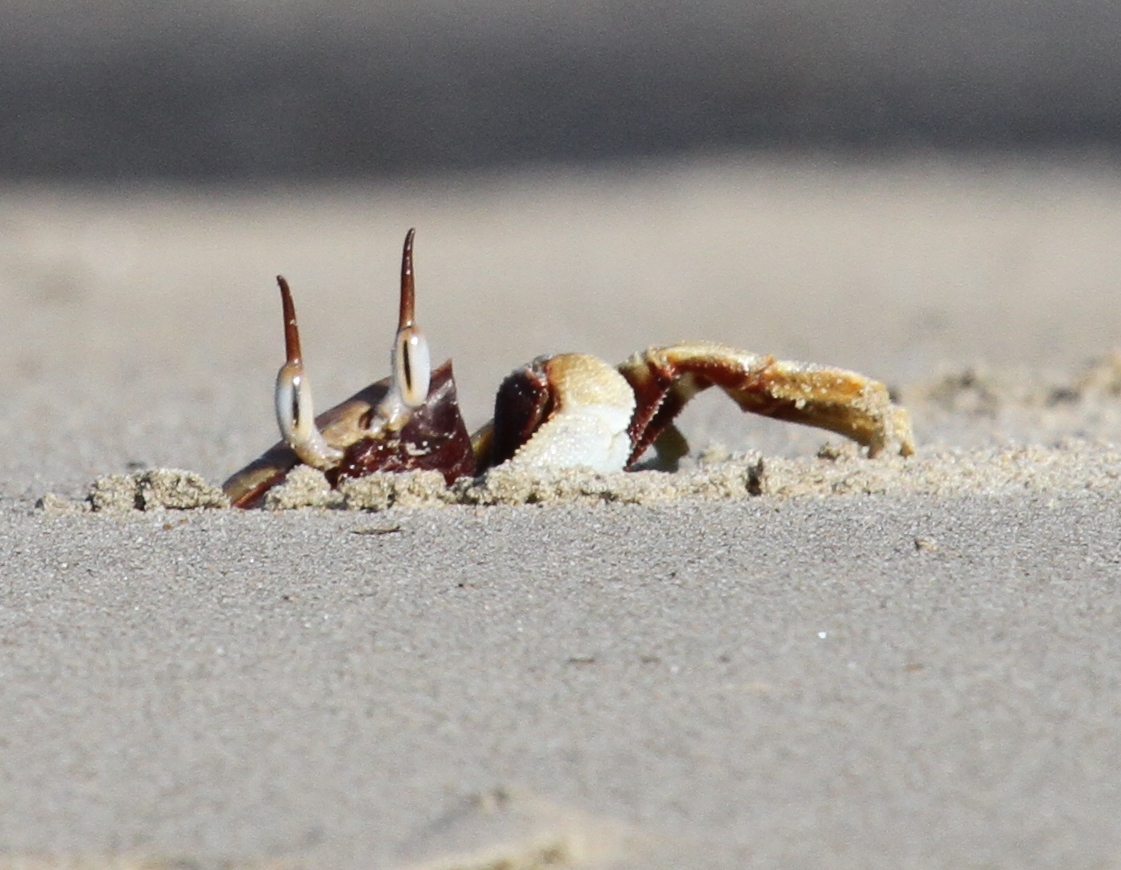
                                                                                Stalk-eyed ghost crabs run along the sand. Then burrow quickly down into deep shafts that takes them into the safe cool depths of the sand.


A hermit crab is tossed ashore by the waves and struggles to right itself in its adopted cowry shell home.


At low tide local fisherman hunt for yabbies much to the delight of children and their parents.


A yabbie is a strange creature to encounter for the first time. What a lot this young fisherman of Coquette Point has to learn and how lucky he is to grow up in a place with rich yabbie beds right at his door.


Red capped dotterels have no problem in finding a feed as they scurry in the ruts of the sand flats. I counted over twenty of these birds in one small area.


Out on the breakwater the resident crested terns were fishing and resting. The young birds I had photographed a month ago have gained their adult plumage.


White breasted sea-eagle was fishing overhead.


While human fishermen were trying their luck with a cast net.


The Johnstone River estuary is a highly productive fishing ground and in its natural state provides a low-key recreational area for the people of Innisfail to enjoy.

Trail or quad bikes, 4 wheel drive vehicles and dogs all pose a threat to this area which is protected under World Heritage Listing. However, the listing is not worth the paper it is written on if enforcement of the laws protecting special places like Coquette Point are not imposed.

Today I had great fun searching for toads. Lee Anne Rollins and her PhD candidate Serena Lam are studying 'The Genetics of Dispersal in an Iconic Australian Invasive Species'. They visited Coquette Point  looking for toads.
 That's Lee Ann and Serena on the right, but what they saw wasn't a toad much to my delight they found a mud skipper in my sediment pond.
After much searching we only found one small toad. I told Lee Ann that I had observed ulcers on large toads and over the last twenty years there had been a marked decline in toad numbers. Once you would see dozens of toads under street lights at night now you are lucky to find one.
If you have any information of toads that would be useful to Lee please contact me for her email address.

Cheers for this week from Jessie, Snout and me.
Yvonne