Saturday, 9 March 2013

Hello from Wompoo country,

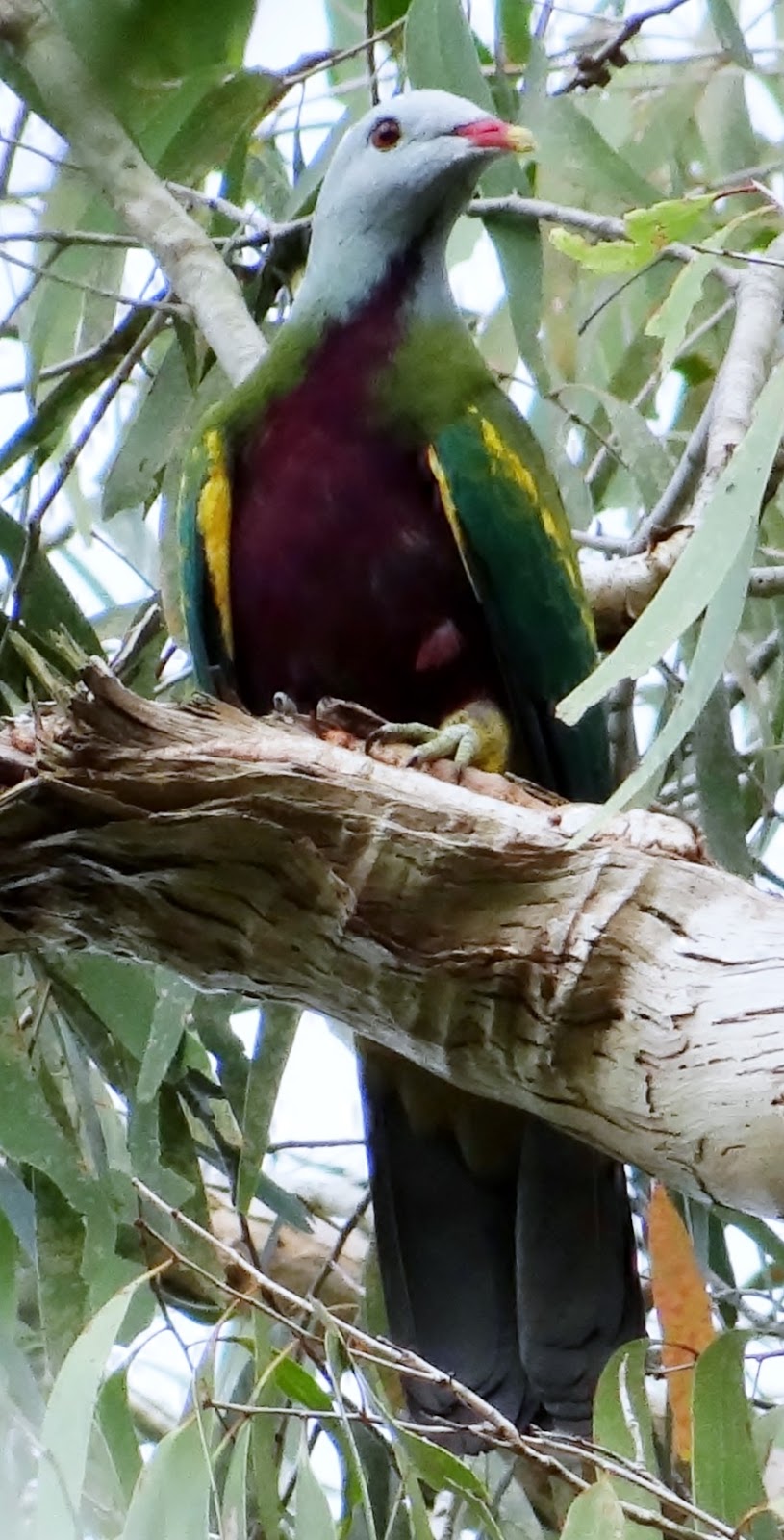
This week the call of Wompoo the fruit dove has been echoing across the rain forest at Coquette Point. Deep in my little bit of rainforest these large, brightly coloured doves are feasting on the ripe fruits of the white cedar, Melia axedarach and the fruits of the strangler fig, Ficus watkinsiana.

Between bouts of feasting one Wompoo came out of the forest and rested in a nearby melaleuca tree. I found her making clucking noises as she looked around and through the tree. Amazingly she allowed me to get quite close and take a series of photos as she apparently sat digesting a meal. How privileged I felt.


While the fig fruits Wompoo eats are edible for humans  the white cedar fruits are poisonous not only to humans but horses and cattle as well.

 Aboriginal people made a cream from the fruits of the white cedar in order to treat skin ailments.

Recently horticulturists have successfully distilled the oils from the white cedar for use as an insecticide.


                        Fruits of the White Cedar, Melia axedarach.


While I was watching Wompoo I heard
 happy chipping sounds. Two little birds were busily hunting for insects which had been attracted to the nectar oozing from the flowers of the umbrella tree.

It was difficult to see them as they moved quickly in and under the shadows of the leaves. I soon realised it was a bird I had not seen before at Coquette Point. It was not until the next day and with the help of my twitchy friend Russell I was able to identify the bird as Macleay's honeyeater and I was surprised as these honeyeaters were catching insects!

The next afternoon they were at the umbrella flowers again but impossible to photograph in the overcast and showery weather.

Unfortunately I have not seen them again but will keep a look out. I asked Ruth if she had seen them at Coquette Point, she hadn't and they are not included on Billie Gill's 1970 list of birds seen at Coquette Point.

The Macleay's honeyeater is apparently common and often seen in Cairns gardens.


The yellow streaked upper breast are distinctive on this little bird as well as its prominent black cap. The belly appeared quite yellow contrasting with the red eye patch. A truly beautiful little bird.

What is unusual for this honeyeater is that its diet consists mostly of insects, about 70%. While 20% is nectar and 10% fruit.

Apparently the flowers of the umbrella tree are its particular favourite hunting ground and of course that is where I found this pair.

Keep a look out in your garden for this busy little bird.


The female Cairns birdwing was also feasting on the nectar of the umbrella fruits. As she placed her proboscis into the fruits she appeared to stand in midair her wings fluttering rapidly.


It was not long before Rainbow Lorikeets also found the rich nectar spilling out from the fruits of the umberalla tree. As they fed on the fruits many red berries fell  offering another feast to ground dwelling creatures.


Rainbow lorikeets are noisely delighted the Quandong tree Elaeocarpus eumundi is covered in nectar laden, frilly, cream blossom. When they finish feasting on umbrella nectar they fly to the Quandong jostling over the blossoms and pollinating the flowers as they do so.

The Quandong tree has a peculiar habit of producing deep red leaves amongst the dense foliage. It is surprising how these leaves help to  create a camouflage for the Rainbow lorikeets.

In a few months the flowers will be followed by bright blue fruits. These fruits are a favourite of cassowaries and fruit pigeons like Wompoo.

Quandong trees grow up to 30m tall and the branches are brittle, as such this tree is unsuitable for ornamental plantings in cyclone areas. This is unfortunate as the tree certainly attracts birds and butterflies. As I was watching the lorikeets feed and squabble in the Quandong one bird flew down and straight past me. Luckily I had the camera ready to catch it in flight. Click on the photo to enlarge you will see it appears to be flying out of the page.

 
While we expect to see peaceful doves foraging in cleared areas, particularly along roadsides, I was surprised to find  one dove pretending to be a shorebird. It was savaging in the mangrove roots and along the tide line on the beach and finding berries to eat. From time to time it pushed its beak into the sand to find more tasty bits!


We experienced a severe tropical storm on Wednesday.
and afterwards the Torres Imperial Pigeon found a branch to dry off .


There have been lots of butterflies active in the fresh air after the storm

I found this Swamp Tiger feeding on the flowers of Ceylon spinach in my vegetable garden.
 Fuscous swallowtail on citrus. 
Green banded blue resting.
 
                                                                     
Every day Grey Reef Heron searches for prawns and small fish within the Johnstone River estuary. I was watching him feeding at the mangrove edge when he walked past only a few feet in front of me and he went to the rocks to fish. I had to pull the zoom back quickly to fit him in the frame. He seemed totally oblivious to my presence. 
He found some prawns washed into a pool in the rocks and
along with a big lump of seaweed, he ate the lot.
 
King tides again this week 3.01 on Thursday morning and this time the tide was helped along with  strong winds of 25 to 30 knots.  Small waves washed onto the beach inside the estuary and it was interesting to watch the interaction of the waves with the driftwood and detritus on the beach. The litter appeared to break the wave and stop them from scouring out the beach. Instead the wave dropped sand and as a result there is now an accretion of sand on the beach. Nature has a  purpose for everything, even beach debris.
 
We can expect more strong winds next week with a low crossing the gulf and entering the Coral Sea. It should be abeam of the Cassowary Coast by Thursday next week. Hopefully, it will keep moving south and out to sea, but be prepared in case.
 
Cheers for now,
Yvonne


Saturday, 2 March 2013

Hello from Coquette Point,

The matriarch cassowary Jessie has returned from her two month long retreat. She is very hungry and I saw her one morning this week just after sunrise enjoying the dragon-fruit I had forgotten to harvest the day before.

As I approached she stopped eating and with a beak coloured red and bits of the fruit's flesh splashed on her neck, she looked at me like a naughty child, her eyes round and innocent.

There were three more fruits ready to harvest and I quickly took them and told Jessie, in no uncertain terms to leave them alone. I don't think she understood.


Summer is over but not the heat nor the humidity. Snout loves to sit in pools of runoff water and was not impressed when I disturbed his ablutions this week.

Normally at this time of the year monsoonal  rains relieves the heat. However, this year the rains and floods have all been in the south of the state and north Queensland has received less than 1/5 of its average rainfall.
                 
Once again Snout has become fascinated with 'Plastic Cas'. Evey day he comes into the nursery and some days spends up to half an hour standing in front of the statue.

Hopefully now Jessie has returned he will loose interest in 'Plastic Cas' and find a real girlfriend.                                     


Orange footed scrub fowl calls out from high on a tree branch.


Orange footed scrub fowls are on the go. Mounds are being piled high with new vegetation  and bossy males call instructions from high up on branches.

Scrub fowls are mound builders and must keep their nest at a constant 33degrees C for the duration of the egg's incubation. As such, they continually add sticks and leaves and sometimes bits of plastic and mulch from the garden to top up their mound. Both the male and the female tend the mound, adjusting the temperature by using their beak as  guide.

These birds have boundless energy when not tending to their mound they busily scratch for insects and grubs in the garden. They will also eat berries and plant roots.

Scrub fowls can destroy a vegetable garden overnight and I have learnt the only way to grow vegetables in the rain forest is to cover the top of the garden area as well as the sides. Thus so, building a barrier to keep them out. I love to hear these birds call to each other through the night shouting the secrets of the rain forest from high in their tree perch to anyone who wants to listen.
   Constantly on the move the scrub fowl scurries across an opening to seek the seclusion of the rain forest.        The scrub fowl's mound is now two metres high.                                                                                                                                                                   
The call of the Wompoo pigeon is one of
the signature sounds of the Wet Tropics Rain forest - wallock--------woo---wallock-----woo. When I heard the call this morning I was astonished to find Wompoo perched on Crested Hawk's lookout tree. Wompoo is known for its secret ways and seldom ventures from under the rain forest canopy. Wompoo is a very large pigeon and is the same size as the female crested hawk around 37cm. I got only one quick photo of this many-coloured bird before she flew out of sight under the trees.
 
The Torres Imperial Pigeons have been congregating in large flocks all week. Yesterday I saw a flock of 50 or more birds flying north. This afternoon I searched the sky for any Ti's moving to their roost and none to be seen. I will check this week it is always sad to see these birds leave for their hazardous journey north. A small tropical low in the Coral Sea and another one in the Gulf will not make the trip easy this year.
Juvenile metallic starlings are looking so cute now. Slowly their metamorphose to shining black is taking place. This particularly adventurous bird I have called spotty. It seems a shame he will loose this unusual spotted pattern.
 
 The Golden Penda, Xanthostemon chrysanthus, is the floral emblem of the Cassowary Coast Regional Council. The golden penda flowers repeatably throughout the year with each flowering lasting little more than a week.

The penda naturally occurs along watercourses withing the rain forest and is is a marvellous sight to paddle along a rainforest creek in water covered by the fallen bright yellow stamens of this tree's flowers.

The botanical name means yellow stamens and the beauty of the flower is certainly in its fragile feathery appearance.

Osprey is hunting for fish every day and he brings his catch back to the nest tree, there is no sign of the female.


Recent dolphin deaths at the mouth of the Johnstone River have raised much concern with residents.

For many years a group of keen ecologists have been keeping an eye on a pod of


rare and endangered humpback dolphins.
Recent sightings of fishing nets strung in the Johnstone River for hours on end without anyone seeming to be monitoring them has raised cocern that these nets and other nets were responsible for the dolphins death.


The net above was strung across the Johnstone River on the Coquette Point side for most of the weekend, a few weeks ago.
This week I spoke to the Steve Howe one of the four licensed netters in the Johnstone River.
Steve told me they were permitted to net from 6pm Sunday evening to 6pm Friday. In addition the commercial netters had a voluntary agreement not to net in the river during daylight hours.

Steve said he and the other fisherman had observed an increase in the number of illegal nets in the river. He assured me that none of the licenced fisherman had killed a dolphin. Occasionally a dolphin or a crocodile gets in the net but the fisherman take care to release them with little harm.
Steve said the catch rate in the river had not greatly changed in 20 years.

Steve would like to see a crack-down on unlicensed netting. At the moment there is a review into their netting licenses and he would like to see any buyback done strategically to reduce the catch by 40%.GED in 20 years.


Cheers for now,
Yvonne


Saturday, 23 February 2013

Hello from blooming Coquette Point,

This week the largest butterfly in Australia, the female Cairns Birdwing, some 16cm wide, are feasting on the sweet nectar produced by the flowers of the umbrella tree. When the flowers open in the warm summer heat the nectar spills out and overflows dripping from the flowers much to the delight of the butterflies and other insects.
Nature is extravagant with colour and quantity and no where more so than in the Wet Tropics Rainforests of far north Queensland.

Frogs have been calling constantly and crested hawk is hungry and on the hunt. I followed the sound of hawk's call to a look-out tree and I found a female crested hawk perched high on a dead tree branch her high pitched call ke-i, ke-i rang out over the rainforest.
The crested hawk or Pacific baza as it is also named has striking golden eyes surrounded by green skin. The female differs slightly from the male with a browner rump and narrow bars across the tail.


The crested hawk feeds mainly on insects but it will take frogs and mice as well as other small mammals.


As I watched this beautiful bird she suddenly turned her head as if saying, are you looking at me?


.
                                                                         With that she spread her wings and took to the sky to hunt over the canopy of the Moresby Range Nationl Park.     What a privilege to have such an experience with a wild creature.                   


The latest brood of Agile Wallaby babies are growing fast and are almost ready to leave the pouch. Dad is never far away keeping guard while mum and babe eat the lush new grass shoots.

Agile wallaby babies stay in the pouch for 7 to 8 months. Although these wallabies are known to breed all year many of the females seem to carry off-spring around all the same age in any one group.

I often see family group of between seven and twelve individuals at the end of Coquette Point.

Do you ever get the feeling of the presence of something or someone? I got that feeling very early one morning  this week.  I was walking down to open the gate and something compelled me to look into the forest where the first rays of light were only just penetrating and there was a Cassowary seemingly sound asleep. He quickly woke and stood up.
In the gloom I saw the cassowaries eyes open with large dilated pupils, it was 'Snout'.. He did not move as he watched me. On the ground I noticed a scrape where the leaves had been pushed aside this had been his bed for the night.
Melaleuca leucadendra trees are in flower all through the swamp. The sickly-sweet smell of their nectar is carried on the hot humid air.
In the melaleuca trees rainbow lorikeets jostle and fight over the sweet nectar.
 
A beautiful dog walked into the nursery on Tuesday wagging his tail he came straight up to me, sat down and barked hello. He was not wearing a collar or any identification.
When no one turned up I realised the dog was lost.
Martin took a shine to him and called him Rusty. It took some drinking and feeding to get his hunger satisfied. I rang around Coquette Point but no one had lost a dog. I called the Council and the new dog catcher was out within 30 minutes. With gentle coxing and handling Rusty was taken away to the pound.
Coquette Point is often used as a place to dump unwanted dogs. Stray dogs in packs are devastating for shorebirds, cassowaries, wallabies and all other ground creatures which live in this part of the World Heritage Wet Tropics. It was good to see Cassowary Coast Regional Council has an efficient and caring dog catching programme.
cheers for this week,
Yvonne


aleuca leucadendraMel


Saturday, 16 February 2013

Hello from murky Ninds Creek,
On Wednesday my neighbour John Kristin phoned me about a dead, skinned crocodile floating in Ninds Creek, a tributary of the Johnstone River.  John had gone down to the Creek to do some work on his boat, which is anchored there, and he discovered a dead crocodile caught in his mooring lines. The crocodile had been skinned and the head cut from the body, it was floating nearby, John could not find any evidence of a bullet but there was jagged flesh around the head as if someone had removed flesh. As the carcass was not smelling and there were no flies present John believes the crocodile was killed and skinned in the early hours of Wednesday morning, just a few hours before he found it.

, ,I phoned Queensland Parks and Wildlife Service and within half an hour a ranger came to investigate. Unfortunately the ranger did not have a boat and apparently is not permitted to go in private boats, however, he did make a report of the incident. We sent the photos to QPWS.  The body of the crocodile was not removed and the next day it was still floating, with the tide, in and out of Ninds Creek.
 Both John and I and other residents have heard, very late at night, rifle fire coming from the river, of course none of us have ever investigated as we all deem it unsafe. If there are people in boats with guns late at night on the river it is perhaps not safe for any other person to go out in a boat at night on the Johnstone River! With the barra season in full swing lots of families do go out at night on the river to fish. 
Skinned headless carcass of a saltwater crocodile found in Ninds Creek Innisfail 13 February 2013.

John also reported when he was coming home from town last week he saw a dead animal on the road. He stopped the car to see what it was and saw it was a very small stripy cassowary chick. The body was so badly damaged he could only identify it from the head. John did not get a photo and the carcass disappeared soon afterwards.


A ridge of high pressure has brought a cool breeze along the coast with good rains every night. Although it is a relief to have the rain, wet at night and sunny during the day are the ideal conditions for breeding mosquitoes and we have lots of mosquitoes at the moment.  Over 50 cases of dengue fever, mostly type 1 have been recorded in Cairns, none in Innisfail - so far. We must be mindful to clean up mosquito breeding areas around the home and encourage the creatures which eat mosquitoes, like frogs, dragonflies and spiders, to proliferate by not using chemicals that kill these creatures when they can bring a balance to our mad world.
Green Water Spider found on a chair in the nursery.

Red dragon fly


On Monday morning I heard the unmistakable call of the black cockatoos. A flock of about 20 birds flew from town to the Coquette Point beach.  I see them every couple of days either flying to or coming back from the foreshore.. 


The Black Cockatoos head straight for the Johnstone
River Almond trees growing along the foreshore, they eat the pulp from the outside and the nuts from the inside of this tree's fruit.
They are wonderfully playful and very noisy. Other people have told me there is a flock of 40 birds south of Innisfail.
I was surprised to see Johnstone River Almond fruit in cassowary scats. I had not observed this before, as I apparently have a fetish for taking photos of cassowary scats I did a search and could not find these fruits in any of the dozens of photos previously over the years of the scats. It is good to know this is another cassowary food tree.
Also in the scat were the seeds from the
noxious weeds pond apple and guava. During the papaya fruit-fly outbreak in FNQ the Department
of Primary Industries led a concerted effort to eradicate plants which were host to the fruit fly such as native bananas, guavas and pond apple. Fifteen years later the pond apples and guavas are as widespread as ever but the native bananas are all but wiped-out of the coastal rainforest and the native bananas were a primary all year food for Cassowaries.
The sunbirds are again in a nesting frenzy.
Damage done to the terminals of plant branches in cyclone Oswald has become an easy source of building material. Above, the broken frond of an Alexandre palm is being stripped by this female sunbird for building material for her nest.
While the sunbirds are busy building nest this season's butcher birds have finished nesting and the babies have all fledged. Lately I have seen a good number of juvenile butcher birds hunting around the nursery and through the open forest for anything that moves; grasshoppers, spiders, lizards and frogs. Butcher birds have the most wonderful song and they are superb hunters, just like hawks.
Over the last couple of weeks we have experience spring tides, with tide range between a high of 3.40 metres to a low of .86 metres. This has energised the river and swept out a lot of debris, much of the debris has been deposited in large floating islands sitting around the mangroves and creating a potential hazard for speed boats travelling at speed at night. Debris like this quickly turns into detritus and  becomes the main food source for crabs and prawns.
 Rivers are dynamic systems and in just a few day everything has changed. We have now entered a period of neap tides where there is very little difference between high and low water.  Now the flow of the river is relaxed and quite.
The high tides chased the little mangrove
crabs from their holes and they have been scurrying around the nursery looking for a dry place to live.
I was taking the photo above when the crab retreated to a safe corner.
The crab withdrew its legs and burnished its
claws in a threatening motion towards me. The next minute major skink came running out from behind and over the top of crab to find sheltered behind my foot. I don't know who was more surprised the crab the skink or me.
It just goes to show ever corner is a home to some creature.
The Torres imperial pigeons have left their nesting
sites in the melaleuca trees and have shifted higher in the trees to sleep at night. The population here has increased by ten birds and I believe they are this years chicks. Lots of long mournful cooing during the early evening. It wont be long and they will be getting ready to journey north.
It was disappointing to see another illegal fishing net set in the river. The person who set this one was so arrogant they left it out until mid morning. It seems in Queensland it is now a free-for-all and the environment is the meat in the political sandwich.
 
Cheers for now from the beautiful banks of the Johnstone river,
Yvonne