Saturday, 9 February 2013

Hello from Coquette Point,

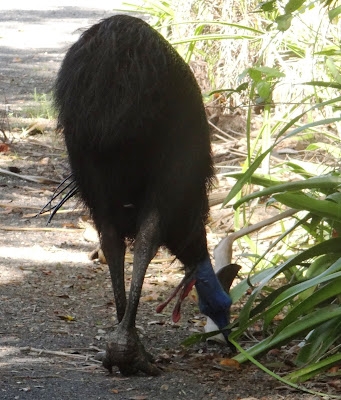
This week a cool change brought some relief from heatwave conditions, but today the heat returned. This week the thermometer reached 37degrees and the cassowaries were heat-stressed. The water in the pond was so hot poor Snout could find no relief and sought refuge from the heat under the trees in my garden.
Good rain last night settled the dust and freshened the rainforest. It is most unusual for February to be dry and to even think of wishing for rain at this time of the year is surely playing with lady luck, however, without the cloud cover that is associated with the rain the sun and humidity is relentless.  All the indications are for rain to set in soon.

At Mission Beach the well know cassowary Sassy found relief from the heat in a pool of runoff water, click on the link to the Mission Beach Cassowaries web-log in the right hand tab to see more cassowary stories.
Below Snout suffering from heat-stress.


Melaleuca leucadendra is in flower and the
green ants are hungrily gathering the fragrant nectar. It is amazing to watch these little creatures and see the cooperation shown by the worker ants while gathering food. We have a lot to learn!
 
When I accidentally cut a leaf on which a migrating Queen green ant had chosen to make her new colony she looked at me in alarm and quickly tended to her eggs gathering them in a heap she splayed her body across the them  and courageously defended the eggs with her life. I relocated the leaf to a safe place and watched her transfer her eggs to a new site where she gathered new leaves together to start the colony again.
 
Like spokes from a wheel silhouetted against the hot summer sky the inflorescence of the umbrella tree Schefflera actinophylla offers its flowers which are full of high protein nectar. These flowers are a favourite of spectacled flying foxes by night and butterflies by day.
The juvenile metallic starlings have grown fat,
they are now the same size as their parents. There is so much fruit available at the moment and  they are confidently venturing forth in flocks by themselves to gather food.
Juvenile and adult metallic starlings hungrily gather
the fruits from an Archontophoenix alexandrae palm.
The white fruits on the blush satinash
Acmena hemilampra are starting to fall rich pickings for the cassowaries and Torres imperial pigeons.
It is always fascinating to watch these
magnificent pigeons feed on rainforest's fruits. No sooner does a flock clumsily land on a food tree, knocking much fruit to the ground as it does, then count the minutes before a Cassowary turns up.   This week we were enjoying a cuppa under the palm trees when the Imperial pigeons arrived, within minutes Snout was there hungrily collecting the fruits as they fell from the feeding pigeons and I might add interested in the cake we were eating as well.
Gloria and Andrew ate the cake before Snout
got a chance to see it.
                                                                                                                                                                                                                                                                                                                                                  The rain and subsequent low pressure system
associated with cyclone Oswald sent the frogs into a mating frenzy. Within a day of Oswald
the little Eastern Dwarf frogs Litoria fallax laid eggs in ponds around the nursery.
It took only ten days for the eggs of the Eastern Dwarf frog to hatch into tadpoles.
Hundreds of Northern Dwarf Treefrogs,
Litoria bicolor have emerged and can be found clinging to leaves in the swamp. Their high pitched wreeeeeek is a constant background noise whenever rain falls.
Coming home from 'a night out with the girls' last night I saw dozens of Striped Rocketfrogs, Litoria nasuta jumping across the road adjacent to the Sea Haven development site. Unfortunately many had fallen victim  to motor vehicles.
Heavy rain fall as I took this photo.
Dozen of Litoria nasuta dead on the Coquette Point road.
 
Let us hope next week will see the monsoon drop down over northern Australia and bring with it a  regular wet season.
 
cheers
 Yvonne


Saturday, 2 February 2013

Hello from hot and sticky Coquette Point,

Like an unwelcome visitor the monsoon surged and dropped down on January 17. Two lows formed on the trough, one in the white-hot waters of the Gulf of Carpentaria and was destined to become tropical cyclone Oswald on the January 21- but only for 12 hours. The weather system soon reverted to a tropical low and danced in the Gulf for a week before beginning its move south. The BOM computer models gave conflicting forecasts on Oswald's movement and at one stage had it sitting over the southern Atherton Tablelands for a couple of days. This area is the catchment for the Johnstone River and if it happened Innisfail would flood. Fortunately for us, but not for others, the system moved over the Tully River catchment and flooded Tully followed by every other town along the eastern seaboard before it moved out to sea at Sydney on January 29.  Flood-waters are still rising in Rockhampton and today the people of north Bundaberg are being allowed in to view the devastation left behind after the highest flood in living memory hit their town.
  The Innisfail catchment received 600mm of rain from Oswald and the Johnstone River ran a bunker with much debris carried out to sea. King tides over the week exacerbated the flooding but did help the river flush.
Oswald moved south and as it passed over Innisfail we experience gale force winds for 12 hours. When it passed we were left in unsettled conditions behind the monsoon. Afternoon storms moved down from the Atherton Tablelands and brought brief, welcome relief from the heat. We are now experiencing hot north-westerly winds and a heat wave which has lasted for six days breaking a record for the most number of consecutive days over 35degrees  and with humidity in the high eighties.

As Oswald moved down over central Queensland causing floods and landslides the Telstra cable carrying all northern commutations lines was disabled along with the back-up cable. Most of Saturday and Sunday there was no telecommunications with the rest of the world, including the emergency 000 phone, and so there was no web-log from me last weekend.

However, what was remarkable, in this instance, when the weather system passed the speed in which the river went from muddy brown to crystal clear.
Storms brought cooling rain in the afternoon.

When the river cleared I saw hundreds of purple mud crabs  swimming in the clear shallows of the Johnstone River. The cassowaries are not in the least perturbed by the rain and with their feather laden with rain drops they continue to harvest fruits and not even bother to shake dry. The photo shows 'Snout' eating the ripe fruit from an introduced weed, devil's fig. This weed is used as a disease resistant root stock on which to graft tomatoes and eggplant. The fruit is also a favourite of pigeons including the Torres Imperial.
 However, in the heat the cassowaries suffer and like to spend their days sitting in water. The heat has also curbed their territorial battles and I noticed old Snout didn't bother to get out of the swamp when young Rosie showed up looking for a feed. 
It is always interesting to watch the animals cope with extreme weather and unlike cassowary  kookaburra does not like getting his feathers wet. When the sun came out he went to some trouble to find a spot in the open to dry off, stretching one wing out at a time to catch the morning sun..
The good rainfall has turned the grass from brown to green and the Agile Wallabies are greedily grabbing large mouthfuls of sweet grass.
Food is abundant at the moment and Lace Monitor had a telling bump in his belly large enough to be a small wallaby.
He was so immobilised by the meal in his belly I was able to approach him and take this close up of his amazing skin patterns.
Lace Monitor in a trance as he digested a large meal.
 
My 70th birthday party was planned for the 26th January and I thought there was little hope of holding it with the weather forecast. A full moon approaching on the 26th and the weather cleared and we had perfect conditions for a party. The Gunduy Aboriginal Dance Troupe entranced my guests with traditional dancing and a welcome to country. Gunduy means cassowary in the dyribal language.
 They were followed by my friend from Tokelau dancing. Ian Rule's band played music to midnight. A wonderful night under the stars. Next birthday party 100 years, 26 January 2043. Are you coming?
 
While we are sweltering in the heat in the cool understory of the rainforest, the Fan Palms, Licuala ramasayii, are in flower, their white inflorescence shining in the dim light.
 
At the roadside edge close to the rainforest pairs of peaceful doves softly coocoo to each other as they feast on seeds amidst the grass and leaf litter.
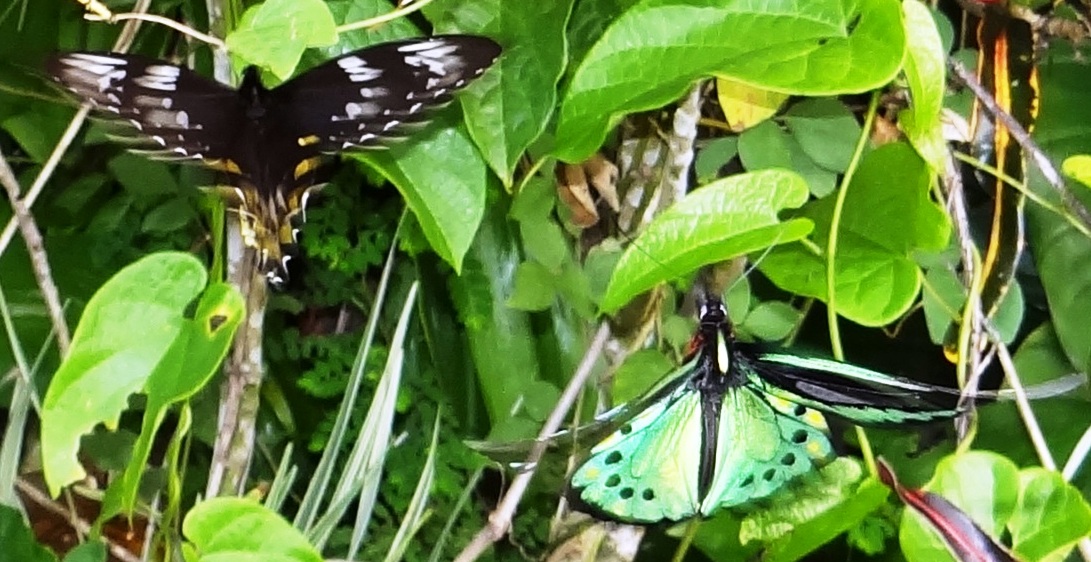
While all around them a flutter of bird-wing butterflies have gone into a frenzy mating and laying eggs in the hot humid conditions.
Male on lower right checking out the female.
 
I reported in the last post what I thought was an outbreak of Chytrid fungus in the white-lipped tree frogs. Deborah from Frog Safe has contacted me and advised that Chytrid fungus is a cool climate pathogen and only shows up in FNQ during our winter months. The frog in my photo does indeed have a problem which is consistent with a Fusarium fungus, a drought tolerant soil fungus. Other soil diseases are likely to be involved and parasites are also likely. The White-lipped is particular prone to
more problems than any other frog species up here. Frog Safe believe there is a primary protagonist involved, which could be a chemical or a pathogen, which is disabling the frogs immune  system. However, they have never been able to secure the funds to get appropriate research done.
Cheers from the Queensland sauna,
Yvonne.  


Saturday, 19 January 2013

Hello from Coquette Point,

The monsoon trough has dropped down and as I speak there are two active lows, one circulation over the Wet Tropic Coast and the other in the Gulf of Carpentaria. We now are in a waiting game to see what will happen.

While most frogs are in their element, with rain falling and are noisily singing love songs I found this white lipped looking very unhappy. She was sitting on a leaf and even when I poked a camera in her face she did not move. I noticed there is a small ulcer on her skin between the right eye and nostril. The skin generally looks unhealthy and the eyes remained half closed in spite of cool rain falling all around her. Her unusual behaviour is typical of chytrid fungus, a dreadful disease afflicting frogs. This is the first time I have seen it at Coquette Point and one wonders if it is linked to the stress these frogs would have endured during the long drought.
 
Pond apples are ripening on the trees and the cassowaries are enjoying the sweet feast. 

All the cassowary scats at the moment contain large amounts of pond apple seed.
As soon as a pond apple fruit falls Jessie rushes to eat it.
While Snout keeps out of sight hiding in the swamp.


Rosie has returned to the end of Coquette Point and she is looking quite beautiful with her wattles developing.

When Rosie turns up Snout chases her with much honking. She doesn't run far and it seems more a game than the aggressive behaviour he shows to Biggles when Snout chases until Biggles is far away.


This young butcher bird has just left the nest and the parents guard it carefully and respond to its continuous calls for food by bringing lizards snakes and frogs.


Jumping spiders are very active this week and the one on the right is a new one for me. It is so amazing to see the diversity of these little creatures.


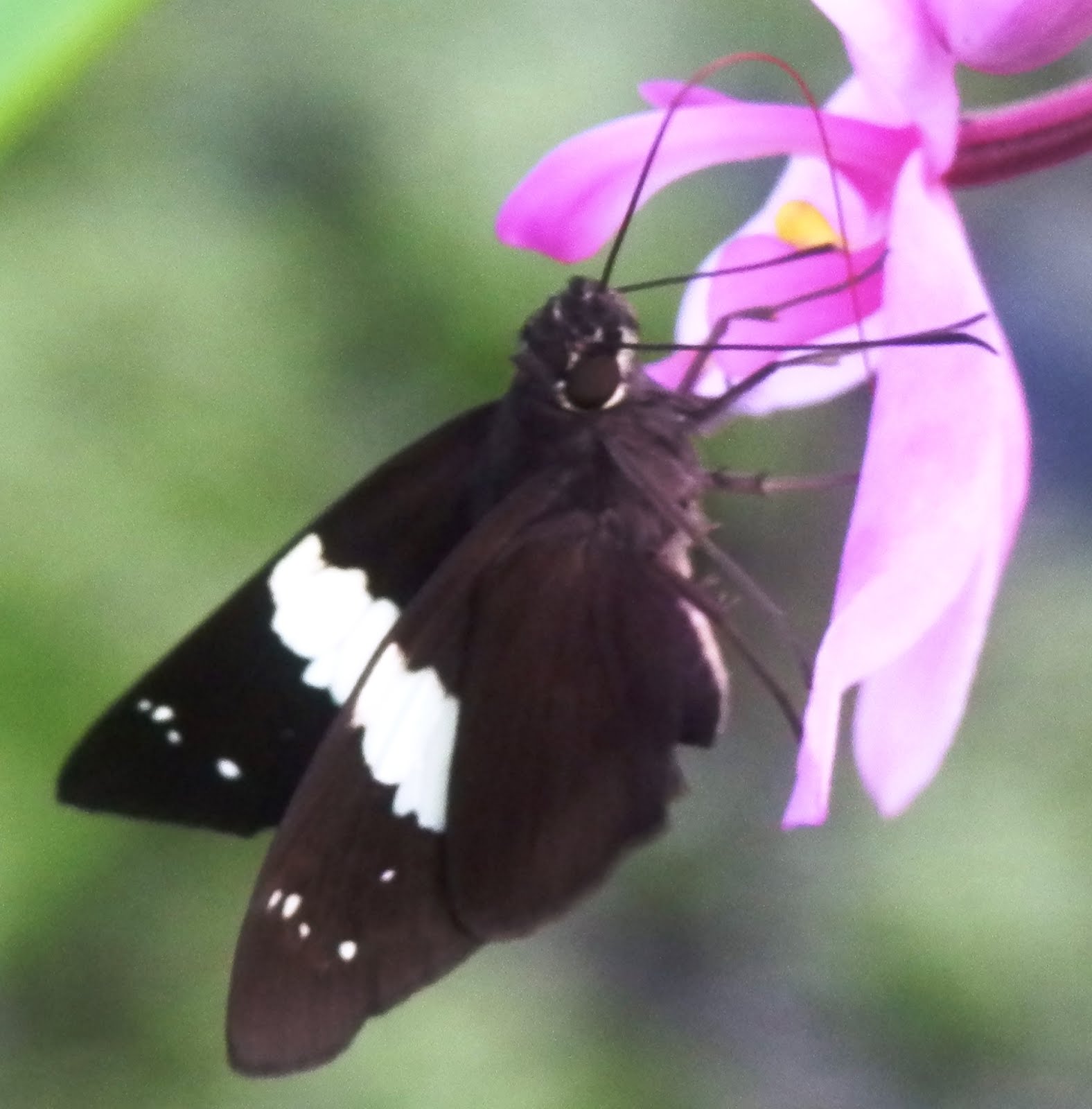
This white barred moth is deeply drinking the sweet nectar of a native spathlogottis ground orchid, flowers are everywhere in the rainforest.
 
Cheers for now and let us hope all remain safe while natural disasters seem to be a part of everyday 21st century life. We know what we have done to cause it but we don't know how to fix it as the tipping point has long gone.
On that happy note cheers,
Yvonne.
 

Saturday, 12 January 2013

Hello from Coquette Point,
While the bulk of Australia is experiencing heat-wave conditions and dreadful fires the coastal Wet Tropics has been under the influence of a weak ridge that is bringing cool sea-breezes with frequent light rain showers:we are having perfect tropical, summer weather. The monsoon trough is sitting over the bottom end of PNG and resisting all attempts by cyclones, like the cat 5 Narelle now off Western Australia, to bring it down over the Wet Tropics.

With the increased moisture and humidity the frogs are in a frenzy and their chorus is a constant background noise in the rainforest and swamp. <
The Eastern Dwarf frog is at its vocal best and the melaleuca swamp pulsates with thousands of these little frogs calling a long wreeek and replying with two pips and all in unison
  
When I went to open the gate yesterday morning I found the spiders had updated my security. A Garden Orb Weaver spun her web between the gate and a tree, anyone trying to enter would have received a nasty surprise. This Garden Orb Weaver seems to like the position and was there again this morning, she generally has the web wound back up soon after sunrise. Garden Orb Weavers  hunt at night and sleep all day in a bed of leaves.
Garden Orb Weaver packs up her web.

However, the Golden Orb Weaver hunts day and night and occupies her web as a permanent base. This spider's web consists of many different types of silk and the drag-line silk has a tensile strength comparable to high-grade steel. For thousands of years coastal fisher-people made fishing lines from golden orb weavers web's silk.
Deadly but beautiful is the nature of much of the rainforest and none more so than the scented Daphne, Phaleria clerodendron. The pure white satin textured flowers form in clusters on the trunk and branches of the tree and release a strong sweet perfume. Phaleria clerodendron is a small understorey rainforest tree and once pollinated the flowers quickly set bright red-apple fruits which are deadly poisonous, every part of this tree is poisonous.
 The small rosy red apples form on the trunk within a month of  the tree flowering and are eaten by cassowaries. 
Mangoes did not set well on the tropical coast this year and I was delighted to see a few fruit high up in one of my trees. With a long pole and much effort I pulled them down, plop, plop. The next minute cassowary Snout appeared out of the forest and like a naughty boy picked up a mango and ran. I gathered the rest and also ran to put them away safely from the cassowary thief.  

Cassowaries respond to the sounds of falling fruits and when the Torres imperial pigeons are feeding on the damson plum the cassowaries are soon on the scene collecting all the fruits the pigeons accidentally knock down. I was photographing the pigeons when the matriarch cassowary Jessie appeared, I had not seen her for over a month. The time also coincided with the top of the King Tide so perhaps she had to move out of the swamp. 
King tide at the end of Coquette Point road.

 
Torres Imperial pigeon knocks fruit to the ground for the cassowary.  
 
Nothing is more indicative of the changing seasons than ant behaviour. Lately I have observed a swarm of Queen green ants spread all over the property. These single dealate-ants are all that is needed to start a new colony. The flighted Queen leaves the old nest flies to a new sight rubs off her wings and builds the frame work for a nursery where she deposits her sack of eggs. The eggs hatch into workers which build the nest structure and a new colony begins. By the numbers of new Queens around there is going to be an explosion in green ant numbers this year. 
Butterfly numbers have also increased
over the last month with lots of Cairns hamadryad and blue triangle butterflies fluttering across the hot, clear blue sky and in the middle of the day they rest in the shade of the rainforest.. 
 
Cairns bird-wing females are
busily laying eggs and some of the females look old and tatty.
 Rainbow lorikeets, just after daybreak, have been nosily engaged in group sex to secure their future.............In the heat of summer it is all happening.
The peace of a perfect afternoon was broken today when I heard a chainsaw in the mangroves on my property boundary. With camera in hand I investigated. 
I found two men chopping up timber in the mangroves. When I made them aware that they were breaking the law they left. The older man said there were no signs saying the area was Wet Tropics and he thought he could walk in anywhere and cut up old logs.
 I will again ask the Council and the Wet Tropics authority to replace the vandalised signs showing the area is protected.
Have a peaceful week,
Yvonne.